
The NY Times published a 2524 word OpEd with dull narrative metrics (3.2%/7) about the need to not be dull in today’s “attention economy.” Kinda funny.
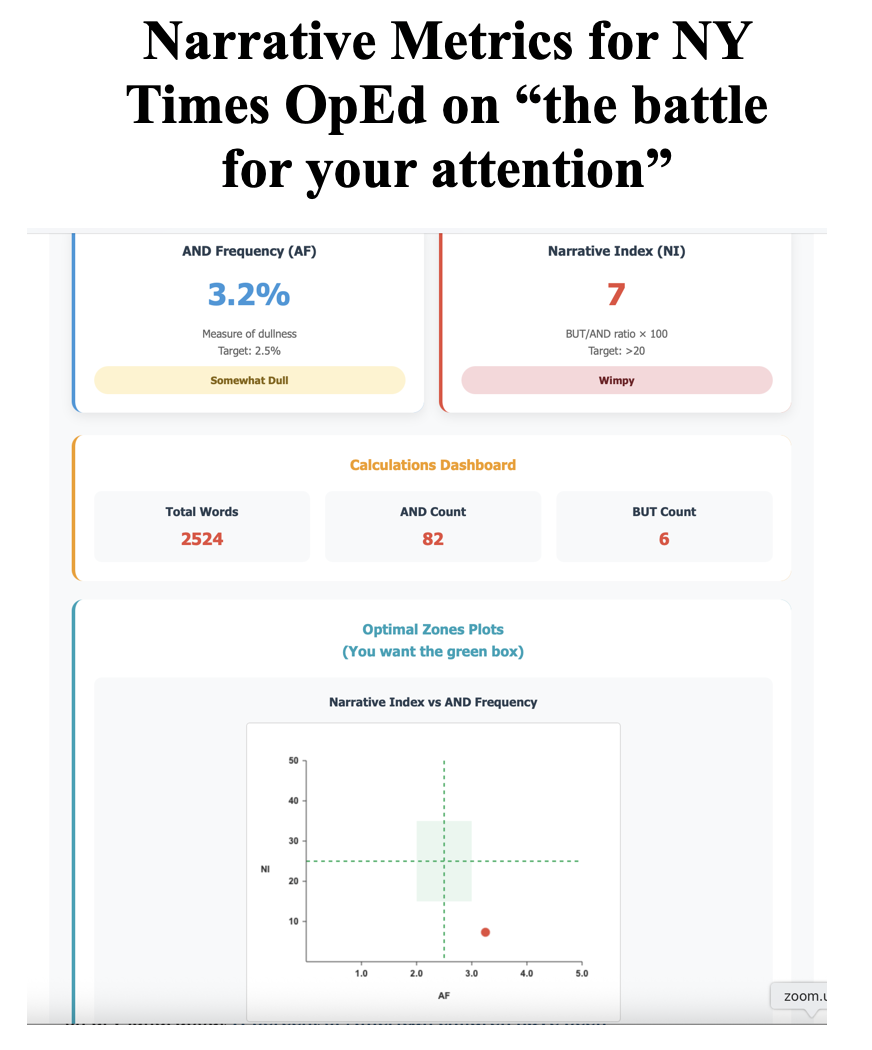
See that orange dot below the green box? That tells you the OpEd was probably pretty hard to follow.
THIS EDITORIAL HAS POOR NARRATIVE STRUCTURE
Where to begin.
First off, most OpEd’s in today’s overly busy world tend to be less than 1,000 words. For some reason, the NY Times chose to publish this piece on Saturday about our attention deficit problems which has 2.5 times that many words. Why?
Second, if we look at the narrative metrics (if you’re not familiar with our two metrics you can bone up on them here) we see two stumbles.
The AF should be around 2.5%. It’s over 3%.
The NI should be over 20. It’s 7.
The former reflects flabbiness of editing, the latter reflects a lack of narrative strength.
Third, look more specifically at the basic opening structure. The conversational ABT structure is basically:
We have a problem, but here’s the problem …
That’s confusing — like a double negative — which academics may love but the general public gets lost.
Specifically, you see it at the start of the third paragraph which opens with, “We definitely have an attention problem, but it’s not just …”
What you want is:
Here’s how we want the world to be, but here’s how it is …
That is how you achieve clear, singular focus.
From there this OpEd sends you off on a journey of, “So what is the main point they are trying to make here?” Which means you’ve lost most people, other than the inner circle who are already deeply connected with the subject matter.
I sent this OpEd to five friends, they all failed to get through it — they found it too “dull,” “unfocused,” “ambling,” in their words. Which might be okay for an essay on sub-prime interest rates, but this was about the need to not get distracted and lose focus.
LEARN FROM A 1940’S FRENCH ACTIVIST?
Lastly, it ends by citing a French activist from the 1940’s telling us why we should learn from her.
Are they aware that the style of mass communication back then was different from today? And if so, how do they propose today’s readers access that material without losing focus and getting bored.
My advice, based on the ABT Narrative Framework we’ve developed and our 15 years of training people in narrative structure is to:
- Keep your essay to under 1000 words (no excuses)
- Get your AF to right around 2.5%
- Get your NI to over 20
- Lay out the dream, contradict it, expand out from there, then bring it back into tight ABT structure at the end with realistic modern recommended actions.
Or … given what it is (a boring essay on the need to not be boring) just publish it in The Onion.