
This isn’t a joke. The Gettysburg Address is your model for powerful narrative structure. Check out our new short video that uses it to help you craft your 2 minute Lightning Talk.
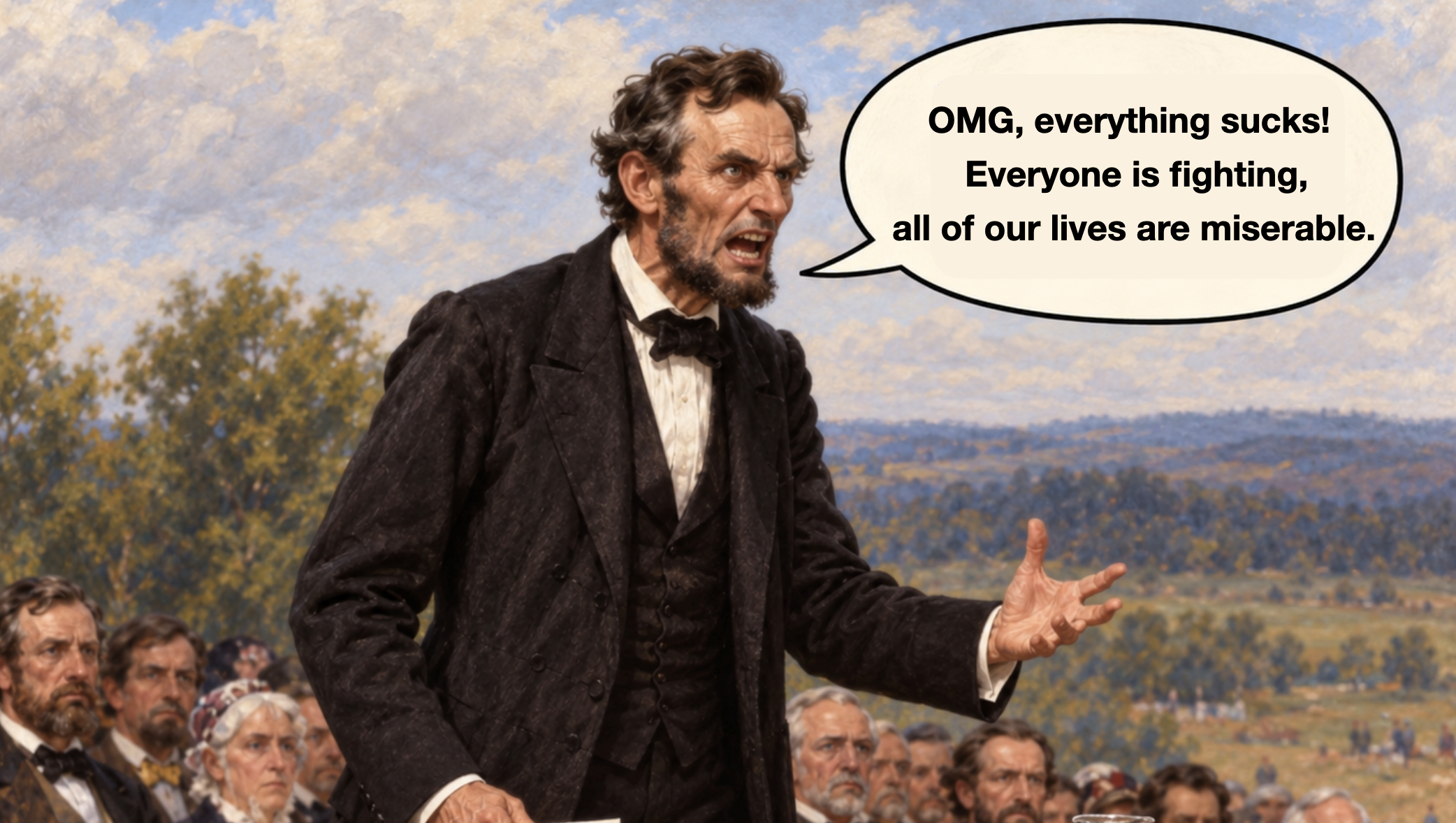
It was a bad time, but still, Lincoln did not open with the problem.
WE KNOW THIS: HONEST ABE HONESTLY NAILED IT
We have a new 5-minute video about the Gettysburg Address (below) that combines history with narrative coaching.
Matthew David and I discuss the new video (below), plus I will be the guest next week on Park Howell’s long-running podcast, “The Business of Story,” to further explore the video.
So, why the Gettysburg Address?
Because it is short, sweet, and pure ABT (And, But, Therefore structure), as I discussed this in my 2015 book, “Houston, We Have A Narrative.”
Yes, the iconic speech is a thing of beauty, but it has much more to offer. Our new 5-minute video shows you 5 hugely important attributes that you need for today’s world in crafting a 2-minute “Lightning Talk.”
They are the following …
1 THE SINGULAR NARRATIVE
If you’re not clear on the power and importance of presenting a single problem (rather than a shopping list), we refer you to Nicholas Kristof’s brilliant, concise article from 2009. Among many points, it brings into focus the overwhelming importance of addressing just one SINGLE over-arching problem. Lincoln did it. So should you.
2 OPEN WITH AGREEMENT
Lincoln didn’t open with his problem by shouting, “WE’RE IN A WAR!” No. He basically said, “We can all agree we’ve got a great country.” Then he introduced the problem.
3 TIME
The most powerful dimension of narrative is time. Lincoln knew this intuitively and thus began his speech 87 years earlier, moved forward through time, then finished by pointing to the future.
4 THE DREAM
Martin Luther King, Jr. of course understood the power of “the dream.” So did Lincoln as his first paragraph points to basically, “the American dream.”
5 ADVANCE THE NARRATIVE
Lincoln didn’t dwell on the problem. No, believe it or not, he was like a TikTok producer of today with a short attention span — he moved right along, on to his THEREFORE.
THEREFORE … to summarize, what you want to do is open with agreement, starting at an early point in time, then present your dream vision, followed by introducing your singular problem, then swiftly move on to addressing what is being done (or should be done) about the problem.
Lincoln knew narrative. You need to, as well.