#210) QUANTITATIVE Analysis of Narrative Strength Applied to NY Times Editorials

Pretty simple. Just look at the BUT/AND ratio for the four main types of editorials in the NY Times. Committees present weak arguments, professionals kick ass, the others are in between.

Two obvious patterns: The committee effort (Editorial Board) presents the weakest arguments. The professional columnists present the strongest arguments. Don’t believe it? Do the analysis yourself, it’s dead simple.


Four categories of editorials

You’ll find four main types of editorials in the New York Times. Three of them are labeled “Opinion” pieces. They are written by: 1) members of the NY Times Editorial Board, 2) Guest individuals, and 3) Professional columnists of the NY Times.

The fourth type of editorial is actually called an “editorial.” It is written by the dozen or so members of the NY Times Editorial Board. This means it is more of a committee effort.

In my new book, Lincoln But Trump, I present two metrics for QUANTITATIVELY assessing the narrative strength of any document. The first is the AND Frequency (AF) which is just the abundance of the word AND in a text.

The second is the Narrative Index (NI) which is this:

NARRATIVE INDEX (NI) = (BUTs/ANDs) x 100

Working with my long-time co-instructor Matthew David, we analyzed 25 each for the four categories, with the selections starting in February this year and working backwards. The NY Times columnists included all the superstars (Maureen Dowd, Nicholas Kristof, Thomas Friedman, etc.). We had one basic rule for “sample size” which is the piece needed to be over 1,000 words (scores get a little weird when you get below that).


What the data show

Of course it’s not the entire story for an editorial. It’s only a quantitative tool. A good analysis also needs the qualitative assessment (i.e. was there a clear theme, a good overall structure, proper framing, consistent advancement of the narrative, and lots more traits that we present in our Narrative Training program).

But the NI at least gives you a simple first “diagnosis” of whether a document argues powerfully or not.

For now, there are no other common metrics for assessing narrative strength. Once you start working with the NI and AF you find yourself looking at every new document and having it be the first thing you think of, “I wonder how it scores with the two metrics.”

They reveal a lot and with almost no effort at all. Go ahead, try it on your own documents. I dare you.


#209) Who Gave a Great Speech at 2024 DNC: Obama Husband or Wife? (spoiler: neither)

An article this week in The Atlantic claims Barack Obama gave a “showstopper” speech at the 2024 DNC. Wrong.


They are of course great and wonderful people (my favorite president of all time), but that’s no reason to view them completely uncritically.


Poor structure: ending with the starting

Context is everything.

That’s what you learn when you spend 5 intense years teaching the ABT Narrative Framework. That’s what Matthew David and I have done since April, 2020 when we ran the first of 42 rounds of our ABT Narrative Framework course.

If you’re not familiar with the ABT and the two narrative metrics you can read about them in the new book, Lincoln But Trump: Narrative Metrics and Similarities Between Heroes and Villains (now available in paperback). You can also see it in the graphic (below) of the Top 6 Storytelling Models for CEOs.

One of the key, recurring mistakes we came to observe is the tendency to end an ABT with the very material that ought to open it. Over and over again we see the recurring pattern of having the last four or five words of the THEREFORE material at the end of an ABT actually be the very over-arching topic that ought to open the ABT.

And that is first sad thing to say about Barack Obama’s largely wandering 2024 DNC speech. I don’t care that Mark Leibovich this week in The Atlantic labeled Obama’s speech a “showstopper.” As history now knows, that show (the 2024 DNC) was already stopped before it ever started, given what it failed to accomplish (a victory for the Democrats).

So without dissecting the entire speech, just consider this one tragedy — Barack Obama ends his speech by saying this in his final major paragraph:

A restoration of what Lincoln called, on the eve of civil war, “our bonds of affection.” An America that taps what he called “the better angels of our nature.” That’s what this election is about.


If that’s what this election is about, why didn’t you tell us at the start?

Context is (again) everything.

How you set up a good speech — yes, how you FRAME it — is no different than telling a good joke. If you don’t set it up properly, you don’t have any impact.

The Lincoln quote was potentially powerful, had it been used properly. It should have been his first paragraph. Martin Luther King, Jr. opened his “I Have A Dream” speech by (correctly) pointing to Lincoln in his first paragraph.

Obama should have opened by simply saying, “You want to know what this election is about?” And then the Lincoln quote, which he then could have messaged around for the entire speech.

But he didn’t. He gave a largely dull speech then ended with his theme as only a final postscript. His wife, who spoke before him, was at least a half level better in terms of narrative strength, looking at the narrative metrics.

Most disappointing of all is to have it called a “showstopper” based on what? Cheering and applause?


The wife wins

In the end, neither speech is all that amazing — a conclusion supported by the mediocre scores for their narrative metrics.

MICHELLE: AF – 3.1%, NI – 15

BARACK: AF – 3.7%, NI – 10

Both AND Frequencies are over 3.0%. That’s not good. In fact, a score of 3.7% is downright bad. “Good” is close to the optimum of 2.5%. That’s what you get with tight editing, as you would find in superior publication such as … The Atlantic.

Neither come close to a score of 20 for the Narrative Index which is the lower bound for most good speeches (Barbara Jordan’s legendary 1976 DNC speech scored 39). Yes, they are beloved personas and rightfully so, but it doesn’t help to view their communications completely uncritically. What they delivered simply weren’t great speeches. This is important to realize at a time when the Democrats desperately do need some great speeches.

#207) Two TV Entertainers and a Lawyer: The Quantitative Narrative Analysis of the Zelensky/Trump/Vance Debacle

The two metrics (NI, AF) are not precise, but they’re very accurate. When someone scores a ZERO for the NI and almost 4% for the AF you know he’s saying nothing. Even if he’s the Vice President.

THIRD WHEEL. The numbers don’t lie. All Vance was doing was taking shallow jabs, not presenting any real arguments. The other two have media brains. You can see it in their metrics. NI (Narrative Index) = BUTs/ANDs x 100 AF (AND Frequency) = ANDs/Total Words

Teleprompter. Scripted. That means written by Stephen Miller brain. Not Trump brain. Trump brain scores in the 30’s with near perfect AF of 2.5%. Miller brain is more cautious, scores in the mid-teens with excess ANDs. All revealed by the two simple narrative metrics (NI, AF).

OVAL OFFICE: TRUMP, ZELENSKY AND A NARRATIVE THIRD WHEEL

The first thing to note is that the president and vice president dominated the word count. They combined for over 1,000 words. Zelensky didn’t even get in half as many.

Second, look at the NI for Zelensky and Trump (which is the ratio of BUTs to ANDs multiplied by 100 to make it a whole number). A normal NI for a politician’s speech would be in the teens, in the 20’s if really good, and rarely — if incendiary — all the way up in the 30’s. Their scores (100, 62) are crazy, yet accurate. They intuitively know how to argue.

Granted, the numbers are a little wonky because of the small sample size. Our usual criteria for analysis is at least 1000 words. Which means the scores are not at all PRECISE. But they’re accurate — both of them were arguing fiercely. If they had gone on for an hour, their NI scores probably would have leveled out in the 30’s.

And then look at Vance. Zilch for narrative content. Give him an hour, he’d probably score about the same.

MEDIA BRAIN VS LAWYER BRAIN

The lawyers in our ABT group will attest to this pattern. It’s the bane of bad lawyers — a pre-occupation with information, all the way into “The Land of And.” Look at Vance’s AF — almost over 4%. That’s a LOT of ANDs.

Then look at the two media-raised brains — both UNDER the optimum of 2.5%. They knew exactly what they were arguing. Few wasted words.

The bottom line is that we live in a “media-driven” society. Trump was pre-adapted to his current leadership role. The media landscape selected him — not just for the qualitative side of his communication (the anger and rage) but even more important, the quantitative side, meaning his grasp of narrative structure (meaning ABT structure). In a society where everyone can’t think straight anymore, he has the depth of narrative intuition that is being selected for. As I’ve been saying since 2015.

And that’s what it’s all about. Narrative selection.

ANOTHER STEPHEN MILLER SCRIPTED SPEECH

When Trump is unleashed, speaking without a teleprompter, his NI scores sail up into the 30’s. But when he is reined in by a Stephen Miller script, he’s back down in the teens. Or lower.

And look at the AF — as bad as his vice president when scripted. But then look at the Oval Office score — below the optimum. That’s the media brain in action.

To read more on this, here’s my whole collection of 25 blogposts on Trump over the past decade.

#181) WORKING CIRCLES: How Story Circles Graduates Can Keep in Shape

Remember our philosophy of, “the narrative part of the brain is like a muscle that needs to be conditioned over time”? For years we’ve had groups ask how to keep the dynamic of their circle going. Now we have a way.


NARRATIVE IS HARD WORK — YOU NEED WORKING CIRCLES

You’ve got a project, it has a narrative, you need help shaping it, who ya gonna call? Maybe some expensive communications consultant? How about you pull together 3-4 people who have been through either Story Circles Narrative Training or the new ABT Framework Course?

Graduates of either have enough familiarity with the basic tools (the ABT, the Dobzhansky Template, the Logline Maker) to give you substantial help. Furthermore, what you really need is not one self-proclaimed expert, but rather a group of 3-4 “ears” who can listen to your ABT and help you strengthen it.

This is what our new WORKING CIRCLES concept offers. For now it’s intended only for graduates of the training, but eventually we may open it up to let outsiders take a shot as well. We’ll see.


HOW A WORKING CIRCLE WORKS

It’s a one shot deal. Someone with a project, proposal, presentation, pitch, whatever, is the “host.” The host announces a set Date and Time for the WORKING CIRCLE. The announcement goes up on the Google Group page. Graduates of the training sign up. When 3 sign up, it gets the green light. If 4 sign up it’s full.

The group meets for a half hour, only. The discussion begins with the ABT then goes from there. Maybe the host has a major breakthrough, maybe the group wanders off topic into a detailed discussion of baking brownies during the pandemic. Either way, something good comes of it — communication.

We’ve just launched the first 5. There’s another 5 on deck. We’ll see how it goes.

The new ABT Framework Course is awesome, BUT … the one thing it lacks (that Story Circles has) is the group dynamic. This is both a way to add that bit of experience, as well as provide a resource that can be drawn on for a long time to come.

The Bottom Line: Everyone needs to be developing the narrative dynamics of their work in a WORKING CIRCLE, sooner or later.

#170) Climate Communication Imbalance: The term that’s needed is “Narrative Equivalence” (not “false equivlance”)

A new paper in Nature (that’s characterized by the standard obfuscation-rich academic style) seems mystified by how climate contrarians can get so much of the public’s attention when they are so few in numbers.  The authors don’t seem to understand the difference between data and narrative, much less know how to consider “narrative strength.”  Yes, in the world of data, it looks out of balance.  But in the world of narrative — where a single anecdote out-weighs a massive sample size — it makes total sense.   This is what should be called “Narrative Equivalence.”  Nothing false about it to the average, non-intellectual.  The challenge is for intellectuals to grasp this.
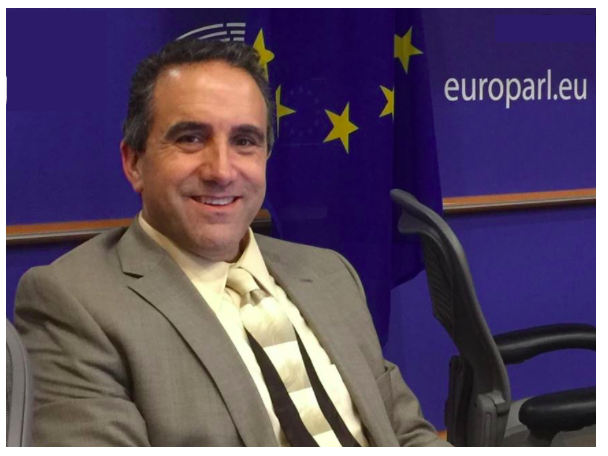
CLIMATE ENEMY #1.  Marc Morano is the most prolific voice of climate skepticism, by far.  His total publications are 35% more than his closest competitor.
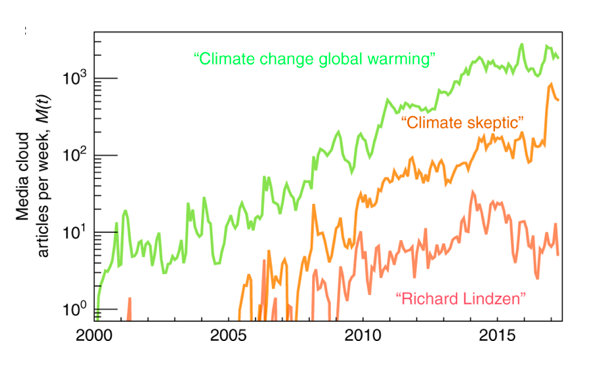
 

A WORLD OF NOISE.  Climate skeptics sure do know how to make noise.


MISTAKEN EQUIVALENCE

For about 15 years I’ve listened to bloggers complain about “false equivalence” when it comes to climate reporting.  In articles like this they bemoan the idea that 97 percent of scientists agree on climate, yet so many articles present the two perspectives as if they were equal in validity.  This is what they call “a false equivalency.”

Here’s how wikipedia defines the term:

False equivalence is a logical fallacy in which two completely opposing arguments appear to be logically equivalent when in fact they are not.

But what if the two perspectives on climate change (that it’s real versus fake) are equal if you use a different criteria than just data (meaning sample size)?  What if the story of a record setting blizzard is more convincing to someone that the climate isn’t warming than a graph showing a net warming of winters.  

The blizzard might have one great, dramatic, painful anecdote of someone freezing to death in the snow.  Such a story might be fairly convincing to many that the climate isn’t warming.  The graph is only information. 

Everyone should read the extremely simple, extremely powerful, extremely broadly written classic 2009 article by three-time Pulitzer Prize winner Nicholas Kristof of the NY Times.  I use it endlessly in my workshops and trainings.  He presents this basic property of narrative that it reaches it’s greatest strength with the story of only one person.  He cites the age old adage (attributed by some to Stalin) that, “The death of one person is a tragedy, the death of a million is just a statistic.”


FAULTY PROGRAMMING

The bottom line, as I’ve lectured and written on for more than a decade now, is that the brain has faulty programming.  Narrative overwhelms the analytical part of the brain.  It sucks, but it’s a fact.  And it leaves scientists handicapped when it comes to communication.  And even further handicapped by the desire to ignore that they have programming faults rather than admit it and work on it.

Here’s the detailed treatment I gave the problem in my recent book, “Narrative Is Everything.”


YES, SCIENTISTS ARE HUMAN, BUT THEY DEFINITELY ARE DIFFERENT WHEN IT COMES TO PERCEIVING NARRATIVE

Scientists actually are different from non-scientists in how they think. That’s what we need to begin with. Remember Jerry Graff’s book title and general template for argumentation? His book is titled They Say, I Say. Let’s use that as our template for where we are so far in our journey through these five broad topics.

“They say” is our first three chapters (business, politics, entertainment). Just about everyone involved in those worlds accepts the importance of the singular narrative. Business people know you want to focus on the one main thing that distinguishes your product from the pack. Politicians know they need a clear singular message. And for the entertainment world, the question of “Whose story is it?” is the basic concession that you need to have one central narrative thread and stick to it if you want to tap into the power of Archplot (classical design) to reach a large audience (meaning the Outer Circle).

In 2012, the bestselling book The One Thing was voted one of the top ten business books of all time on the website Goodreads. It was custom-made for the business world, but it didn’t begin to suggest applying singular thinking to the world of science. Here’s why.

THE FUNDAMENTAL CONUNDRUM: THE SINGULAR NARRATIVE VERSUS GIANT SAMPLE SIZE

Scientists love big numbers—especially when it comes to sample size. As a scientist, you spend your life gathering and analyzing data. There is always this relentless force driving you to obtain larger sample sizes. It gets programmed into your psyche: big number good, small number bad. The worst number of all is one, the “anecdote.”

When you listen to a talk and the speaker says “exactly 40 percent of the moths were white,” you get a squeamish feeling. You think, “please don’t tell me you observed only five moths, and two were white …”

But then the speaker puts up the data and the value mentioned is actually 40.246%. You begin to relax. And then you see the sample size was 1,283,472 moths, and you say to yourself, “Wow. Over one milllllllion moths!”

You feel very, very good just looking at that large number on the screen. At the same time, you retain your dread fear of a sample size of just one. And of course that’s what an anecdote is: a single instance. It’s “n equals one,” in the parlance of scientists.

ANECDOTES: THE BANE OF SCIENCE

Storytellers love the singular narrative, which means they love the anecdote. Take a look at any issue of The New Yorker, and you’ll find at least one article that opens with an anecdote about one person.

In fact, let’s put this to the test right now. I’m opening up the March 18, 2019, issue of The New Yorker, which I just received yesterday. I’m seeing an article called, “The Perfect Paint: Farrow and Ball’s Selective Palette Is Creating a New Kind of Decorating Anxiety.” I’m turning to the article, and I’m reading the first paragraph, which begins with, “When Haley Allman and her husband bought an Edwardian town house … ” And there you have it—it opens with the story of one person, Haley (her husband is just an added detail)—the classic anecdote.

You can find at least one major article in just about every issue of The New Yorker that starts like this. The singular anecdote provides immediate focus and locks in your interest while conveying the basic theme of what’s about to be explored. But to scientists, it’s fundamentally wrong.

I developed an intimate familiarity with this in my science career. For example, one of my marine biological projects involved diving under the ice in Antarctica. The climate there was brutally cold, and for one starfish species we studied, I was only able to find one individual of the species and make one measurement. When it came time to publish a paper about the project, there was discussion over whether I should be allowed to mention that one observation, since it was “just an anecdote.”

The discussion came down to the question of whether the world of science would be better off knowing this one tidbit of unreplicated information, or whether science would be better if no one ever even heard it. It’s a bit like a judge ruling on whether hearsay evidence is admissible in court. We chose to not mention it. (P.S. The only recording of that one measurement was in a notebook that was in my house that burned down, so the world will never know that tiny piece of starfish data, boo hoo.)

This is how scientists are absolutely different from non- scientists. You are trained to be suspect and spurn anecdotes and be suspicious of them. And yet, the brain of the average human loves them—as exemplified in the extreme with the examples from Nicholas Kristof I mentioned in the first chapter about the advertisements of children dying in Africa. That communication was at its most powerful when the sample size of individuals being talked about was one.

So scientists dream of communicating in this somewhat non- human, anecdote-free manner that involves the luxury of running through all 43 points you want to make. When I work with them I can usually convince them that 43 is too much. But when you start to get down to their wanting to tell three stories versus my recommending they yield to Dave Gold’s single Christmas-tree model—that’s where it can get ugly .

They will push back, saying there is no one single story. I will push forward, saying, “Maybe there is, and you just haven’t realized it yet.” They will say three is good enough, I will try to point out there is greater power in the singular narrative and they will start to glare at me as though I am the enemy. I’ve been through it many times.

Scientists are different this way. I know because I used to be one. They yearn for an AAA-accepting world, but the truth is, they are the ones who have produced the technology that has glutted our world with information, resulting in even less tolerance for the AAA form. The world used to be more AAA, but narrative selection has changed the landscape — which will be our major topic for Chapter 6.