#14) “The Big Short” is an Excellent Educational Film

The filmmakers would probably hate it to be labeled as “an educational film,” but it’s true and is the highest praise. They pulled out all the stops to help the public understand the enormity and permanence of Wall Street’s crimes of the past decade.
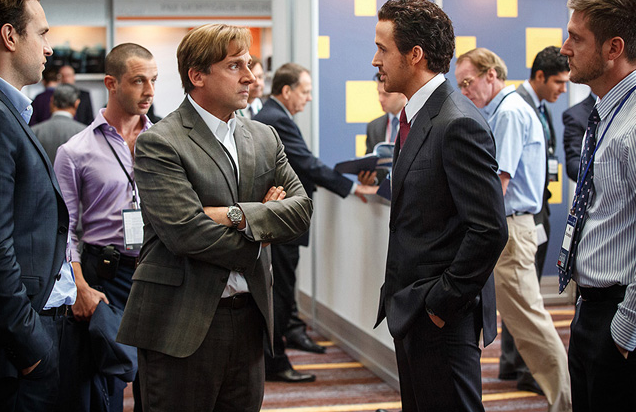
Would you buy a used car from either of these two guys? Great movie.


SADLY, THERE’S NOBODY TO LIKE IN THIS MOVIE

I went to an advance screening of the upcoming movie, “The Big Short,” (coming Dec. 11) based on the Michael Lewis book. It’s a fascinating and challenging movie — forcing you to run full speed with them as they do their best to explain all the tricks and cons at work on Wall Street in 2006, when the housing market bubble was getting ready to burst.

It almost feels like a Discovery Channel show at times as they bring on all sorts of fun non sequitur cameos to explain the most complex concepts — like chef Anthony Bourdain at his chopping block using squid and halibut to explain derivatives (I think) or Margot Robbie in a bathtub explaining another concept while of course sitting in a tub full of bubbles.

There’s also a lot of breaking the fourth wall — actors looking into camera to explain what’s going on — almost like having a “benshi” at times (the name of my old blog!). It’s very complex material, yet they don’t shy away from trying to get the audience to understand what happened.


A BRAVE MINIPLOT EFFORT

If you read the section in my new book about the fundamental divide between the more narrative form of archplot versus the more truthful form of miniplot, this is a movie that draws on all its muscle of star power and creativity to do an honest, as-accurate-as-possible miniplot job of conveying the truth. At one point, for one particular sequence, an actor talks into the camera and admits the real events didn’t happen like this for this bit, but that only strengthens the credibility of the rest of the film — that they would concede the few places where they did significant fabrication for dramatic purposes.

It’s really an excellent movie. It won’t reach as large of an audience as if they had gone the more archplot route of synthesizing a fictitious character who could then experience all the stages of The Hero’s Journey. And that’s just more reason to admire the filmmakers.

One more interesting twist — it’s directed by Adam McKay. Let’s see, what great hard hitting dramatic epics is he known for? Let’s start with “Anchorman: The Legend of Ron Burgundy,” and “Step Brothers.” That’s how much the producers pulled out all the stops to make this very difficult yet important material watchable for the masses — they knew they had the solid factual story from the book by Michael Lewis. To that they added an incredible team of actors topped off with a director who knows how to lighten things up.

In the end, it’s a fairly sad and cynical story. There really aren’t any winners. Even the guys who became billionaires from their investment savvy ended up feeling at least a twinge of guilt that they did it off the savings, homes and retirements of all the less fortunate of America. And as most people know, only one of the culprits from Wall Street ever went to jail while the corrupt system underwent just about no reform. It’s a tragi-comedy of Shakespearean proportions.

 

#13) Great Article in the New Yorker on the B.S. Nature of Polling

A metrics-driven society inevitably ends up with metrics-driven debacles. For polling, the tradition of bogus results goes back to the 1940’s and is stronger than ever today. What’s the consequence? In a “Trumpian culture” (as the article terms it) the power is to those who have a command of narrative.

WHO NEEDS POLLS WHEN YOU’RE A MASTER OF NARRATIVE.


THE BOGOSITY OF POLLING

In 1992 I helped with running phone polling for Bill Clinton’s Presidential campaign in New Hampshire. I was a professor at UNH and it was still the first in the nation primary state. For probably a dozen nights I did phone calls with about five other people in the small campaign office in Portsmouth.

What struck me the most was the number of hang-ups. Not many rude comments, just the majority of people not wanting to answer the questions we were calling to ask. That was the start of my big time susipicion of all polling data. Why weren’t we concerned about the biases of this huge level of non-participation?

This is a major dimension of Jill Lepore’s excellent article in this week’s issue of The New Yorker titled, “Politics and the New Machine: What the turn from polls to data science means for democracy.” She has just the sort of critical perspective I subscribe to The New Yorker for, diggin waaaay back into the history of polling in America to show how much of it has been bogus for at least 70 years.


A HISTORY OF EPIC POLLING DEBACLES

You would have thought polling itself would have gone extinct in 1948 when Gallup himself said of his prediction that Dewey would beat Truman the whole world would see, “how good we are.” He should have been tarred and feathered back then with “Gallup” being as culturally discredited as Benedict Arnold, instead of giving rise to the sacred Gallup Polls of today.

The article points out how the process of polling in America (which emerged in the 1920’s, back when it was exciting to be asked your opinion, resulting in over 50% participation), has now dwindled to “single digits” for almost all phone polling. Meaning I wasn’t alone with my New Hamphire “no thank you” experience.


POLLS SUCK

In 2005 when I set to work on my documentary “Flock of Dodos” about the evolution controversy in Kansas I listened to my interview subjects talk about the “statewide” polls on support for the teaching of evolution. Which seemed impressive except for one minor detail — my younger brother, who at the time worked in the oil fields of Kansas — kept reminding me, “NOBODY in this state cares about this stupid issue — they care about jobs — it makes them angry when they see evolution on the front page of the newspaper.” Which I had already sensed just from talking to my old high school and college friends there. The public concern was largely manufactured by journalists.

The thought that kept running through my head ends up being exactly what Lepore addresses. She writes, “The first question a pollster should ask,” the sociologist Leo Bogart advised in 1972, is, “Have you thought about this at all? Do you have an opinion.” EXACTLY!!!

That is exactly what I kept thinking — how many of these working class people in Kansas have really digested this issue of evolution versus creationism and decided they have a clear and strong opinion. The number was probably statistically indistinguishable from zero. So much bogusness.


CLIMATE AND ENVIRONMENTAL POLLING

Thus my concerns for today. Who are the people being polled for the endlessly quoted and worshipped climate polls? So much bogusness. So much time and resources spent on numbers, some of which become self-fulfilling — “Well, we were going to launch a campaign and actually DO something, but … our polling shows …”

The concern is sample size. How do you extrapolote a poll of 200 Americans to a population of 200 million voters? Lepore addresses these very concerns in her article. The answers she encounters further define the bogosity of it all — especially quoting Bill McInturff of Public Opinion Strategies saying, “The people we have trouble getting are less likely to vote.”

He’s saying they are confident that their tiny sliver of the population who will actually answer their questions are enough to gauge the entire voting public. Says who? What’s that based on? Probably a poll of voters asking them who they think are most likely to vote. Piles of endless circularity.

The fact is people worship data. I still love the quote from uber-cynical climate skeptic Fred Singer in my movie, “Sizzle: A Global Warming Comedy,” who talked about models he was commissioned to create to predict the price of oil 50 years in the future. The people paying him knew the models were bogus, he knew the models were bogus, and nobody cared — he got paid and they got their numbers to argue with. Ugh.

There are not enough critical journalists in the world like Jill Lepore. Which is a shame. Her article is excellent. At the core it is questioning of “scientism,” (the worshipping of science, including metrics) which is what the world needs more of.


ABRACADABRA TRUMP!

Anyhow, do the math (bad pun), add it all up, and the net result ends up being Trump. Very simple. In my webinar on Dec. 1 I’ll mention how with the ABT you can show quantitatively that Trump has a far better grasp of narrative than the other candidates. And actually, you don’t even need the numbers — just understanding narrative structure a bit you can see how he is a master of it, talking in tight loops of problem-solution (albeit cheating), in a way that the masses love. In the language of Robert McKee, Trump talks archplot, the other candidates (especially Democrats) talk miniplot.

He’s dropped a bit in the polls, but he still has the commanding presence. As Lepore mentions, the polls these days are based on such small sample sizes and have so much noise they are virtually meaningless. Which is why, as she points out, there were recent total poll shockers in the UK and Isreal, not to mention poor old Mitt Romney thinking he was going to win. It’s all cuckoo.

The best line of the article is quoting Arthur Lupia who says that horse-race polls (like the current Presidential polls) should be labeled, “For entertainment purposes only.”


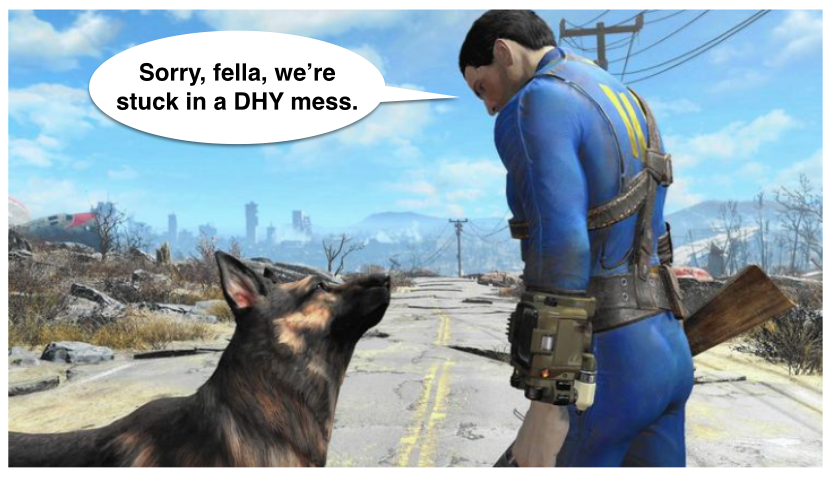
#12) Fallout 4: A Victim of DHY

Most video games are about story — some more than others. The LA Times review of the new game “Fallout 4” dings it for errors of both AAA and DHY, though they don’t have the terms for it.

This is what we’re talking about with the ABT Framework. Once you get down the basic elements of the Narrative Spectrum, you start seeing them everywhere. Like the LA Times review of the new video game “Fallout 4.”


10 HOURS OF AAA

Stories begin with AAA (and, and, and). It’s called exposition — an assemblage of neutral facts that don’t yet engage the narrative centers of the brain. Not enough exposition and the story is confusing. Too much, it’s boring.

The LA Times reviewer for the new video game Fallout 4 says it took him 10 hours just to get to “the game’s first major city,” which he says was the first moment he began to actually warm to the game. That’s kind of like the end of the first act — the story is finally up and running, the audience is engaged.

He goes on to lament about that being just too much time — pretty much like a movie that takes forever to get to the first dead body. That’s an AAA problem — too much, “AND then we learn about this, AND then we learn about this, AND then we learn about this …” Enough already, get on with the story.


DHY IS ANTI-SVELTE

What’s a bigger concern is the overall feel of the game being just too complex. After 10 hours of play the reviewer says, “It still feels as if I’ve opened a board game for the first time, and before me lies the virtual equivalent of hundreds of tiny plastic pieces and the overwhelming dread that mastery won’t come easy.” This is the situation I’ve described in my new book as DHY — Despite, However, Yet — representing the situation of too many narrative directions at once.

It’s clear that the game is just too muddled — too much narrative, too many directions, too much detail. It lacks the simplicity of narrative that make stories popular. He reflects this by making references to simpler games of which he is more fond, by saying, “I miss the ease with which Lara Croft traversed ruins, and I miss the relative svelte nature of its story.”

The point of this post is not about video games (I don’t have the time to spend 10 hours just getting into one, though I wish I did). The point is how broadly the Narrative Spectrum applies to any world in which story is present. Show me a story, any story, and I’ll show you the forces of AAA, DHY and ABT at work.


#11) Story Circles Goes Operational at USDA/ARS

Last week we launched two new Story Circles with the U.S Department of Agriculture/Agriculture Research Service (USDA/ARS). Story Circles is past the experimental phase of last spring and is now operational.

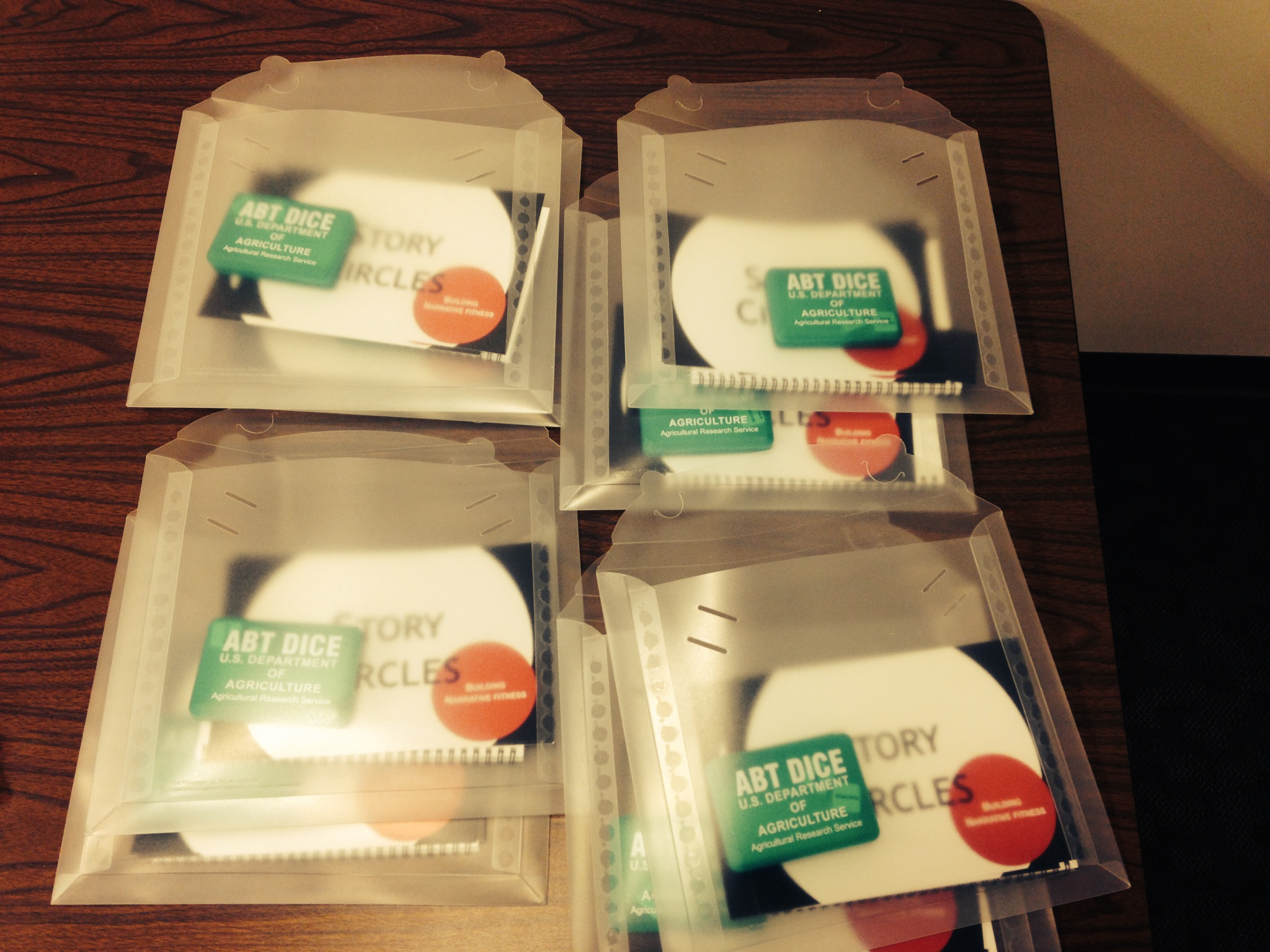
STORY CIRCLES KITS. This is where the training begins, including the new ABT Dice.


NARRATIVE FITNESS TRAINING: USDA/ARS EMERGES AS THE MODEL

Last spring we developed our Story Circles Narrative Fitness Training, running four prototypes at three locations. They ran surprisingly smoothly with only a few bumps to iron out over the summer.

Of all the locations, the one that emerged as the best was with the U.S. Department of Agriculture in their Agricultural Research Services program (ARS). Specifically, their Office of Scientific Quality Research (OSQR, they call it Oscar) is heading up the effort. They are the folks with the greatest vested interest in improving the narrative quality of their project proposals (called Project Plans). They, more than any other group, quickly took to Story Circles.


STORY CIRCLES GOES OPERATIONAL

Now we’ve moved out of the development phase — Story Circles is now operational. We just launched two new Story Circles with the southeast region of USDA/ARS — one “local” with five research scientists at their Fort Pierce, Florida research station, the other “remote” — five research scientists from several other locations who will hold their sessions via teleconferencing which will be the first time for this.

I was in Ft. Pierce last week to run the one day orientation session for both Circles. Unlike last spring, where it felt like we were making things up as we went along, now it is feeling firmly established. It works, it’s relatively simple, and now it’s up to the participants to put in the effort to make it effective.

If there’s one thing we learned from the prototypes, it’s that you get back what you put in. The harder people worked on the materials, the deeper the feel for narrative structure they gained. There are several other government agencies now talking to me about introducing Story Circles to their employees. It looks like USDA/ARS will be the model for all the others.


#10) SHRINKING THE RIVER OF STORY

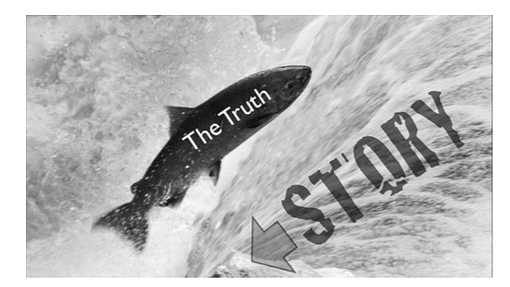
Last Saturday night CBS 48 Hours Mystery (one of my favorite shows) presented a fascinating case if you’re a fan of story structure. A prosecutor tried once and failed. Then on his second try, he basically shrank the river of story and won.

THE TRUTH SWIMS AGAINST STORY. (Figure 15 from “Houston, We Have A Narrative”). The fish of truth has a hard time when forced to swim upstream against the river of story, BUT … what if you shrink the river of story?


THE BUGS BUNNY “BUWWETS” CASE

Last Saturday night my favorite TV show, 48 Hours Mystery aired a seemingly silly, but ultimately fascinating case. It fits right in to the dynamic of the fish of truth and river of story dynamics I present at the end of, “Houston, We Have A Narrative.”

The murder case itself was pretty weird. A woman shot her husband of 15 years in the head twice, then claimed it was an accident, caused by their imitating a Bugs Bunny episode.

The story she spun in the initial trial was so unusual, specific and almost plausible that it ended up overriding the huge body of forensic evidence presented. The proscuting attourney, similar to so many prosecutors who present mountains of science-based evidence, was fairly stunned when the jury voted to acquit — as stunned as an evolutionist with all the science-based evidence who loses a debate to a creationist telling great stories.

Some of the jurors bought her story. She claimed that she and her wacky husband routinely quoted Bugs Bunny scenes to each other. In this case she picked up his handgun, he said, “no buwwets,” quoting Elmer Fudd, then she started “fan firing” the gun (similar to old western gunslingers holding down the trigger while “fanning” the hammer for multiple rapid shots). He leaned forward into the line of fire and oof, took two in the head, lights out.


LESS STORY TURNS OUT TO BE MORE

Years later the woman was retried for the murder. This time around the prosecutor made a savvy decision. He opted to not present any of her post-arrest interrogation where she told about the Elmer Fudd thing in detail. Because of this, the whole wacky buwwets element never came up. The defense kept expecting him to get into it. He never did. As a result, all the jury got was the science-based forensics information.

Unlike the first trial where the jury ended up deadlocked after several days, in the second trial the jury took only one day to reach a decision — guilty. The prosecutor attributed it entirely to the removal of the Bugs Bunny element.

Bottom line, in the language of story — if you shrink the river of story (if it goes against the truth), the truth stands a better chance.


#9) Operation ABT: The War on Boredom

It’s time to begin the all-out offensive on boredom.  We have found the enemy (the dreaded “and, and, and” structure) and we have the weapon with which to destroy it (the ABT).  Next month in workshops with USDA and USFWS, then a webinar in December, we will unleash the first stage of the campaign.  Some day, boredom will be a thing of the past.

PastedGraphic-4

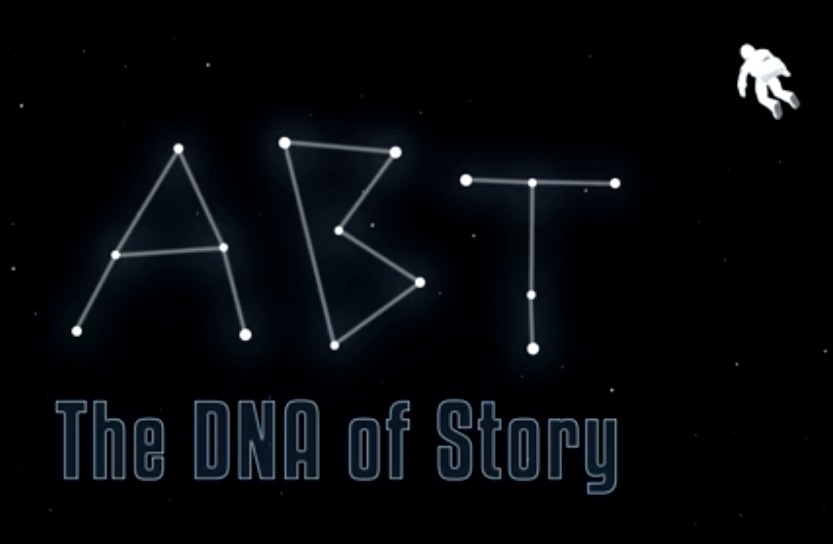
ABT:  THE DNA OF STORY.  Most of what you need to know about narrative dynamics, boiled down to just three words.


OH, NO, HE WANTS TO KILL THE AAA?

Don’t panic.  Just having some fun here.  The first wave of reviews on the book are out and they all have one thing in common: an appreciation of the power of the ABT.  Nature called it “the backbone of story” and the Science review at least quotes me saying it’s awesome (good enough).

It is indeed awesome, and is the central element of most everything I do now.  Next week I’ll be launching two new Story Circles with USDA in Florida (training built around the ABT), then a couple weeks later will be in Madison, Wisconsin to run an ABT session with 50 scientists from US Fish and Wildlife Service and other government agencies.

In addition to these training sessions, at the start of December I’m going to do a webinar on the ABT with a number of organizations.  If you haven’t watched the 2 minute animated ABT video, here it is — share it with everyone who is bored with boredom.

Lots more to come as we seek to rid the world of the “bo-ho-horing.”


#8) The Nature Review

The book was selected as one of five Books in Brief this week in Nature. Coming soon is the Science review.

Nature Paragraph for Book

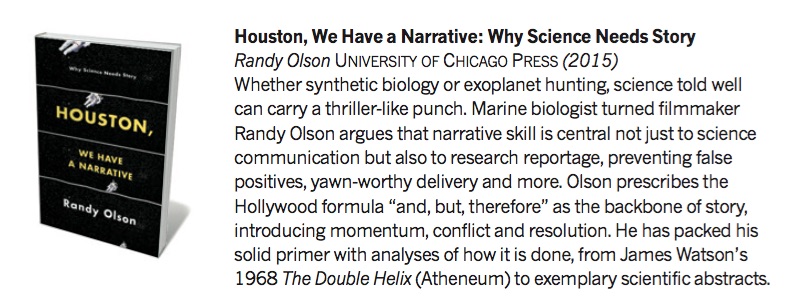
HOUSTON, WE HAVE A BOOK REVIEW (albeit tiny).  Nice that they picked out the ABT elements and called it “the Hollywood formula.”  What they meant is, “Aristotle’s and all of humanity’s formula.”


#7) The IPCC Needs the ABT Framework (#ABTFramework)

NEWS UPDATE:  Journalists are now telling us that scientists are saying something about “the end is near,” but they can’t quite make out exactly what the scientists are saying because they are so hopelessly confusing and boring.  

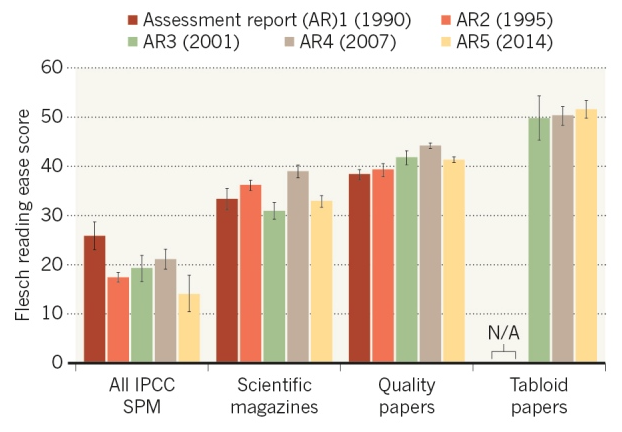
A report last week in Nature says communication by the IPCC has gotten worse over the past decade, not better.  The IPCC needs the ABTFramework.  We are now propagating the ABT approach at USDA (I’ll be running another two Story Circles next month).  One science group has already used the ABT to fix their statement to the upcoming Paris climate meetings.  People have been complaining about the poor communication efforts of the IPCC for years (John Sterman had a note about it in Science in 2008). They need the ABT Framework.    Actually, so does the Flesch-Kincaid Readability Test, developed in 1975 (it’s 2015, we now know things about the importance of narrative structure).  Come on, everybody, we can do better than this.

 PastedGraphic-6


INCREDIBLY PERMANENT COMMUNICATION CHAOS (IPCC).  Apparently the journalists are getting better at communication as the IPCC gets worse.  What a great way to watch the world end — journalists telling us really clearly that they can’t understand what the scientists are saying.


SOME THINGS SEEM TO NEVER CHANGE

It was 2008 when my good friend John Sterman had his MIT math and science grad students read the executive summary of the last IPCC report and try to translate it into understandable language.  In so doing, about half of them got wrong the basic contents of what the summary was saying.  He published a great short essay about it in Science, saying if MIT grad students can’t understand what you’re saying, how do you expect the public to.  You would have thought the IPCC might have improved things in response to being called out.  Not even close.


AS BORING AND CONFUSING AS THEY WANNA BE

This isn’t me doing the criticizing — it’s in Nature last week in an article titled, “UN Climate Reports are Increasingly Unreadable.”  And you want to know what’s really sad in that article — they quote senior climate scientist Michael Oppenheimer saying, ““If newspapers and other intermediaries are doing a progressively better job of communicating IPCC findings to the larger public, and if governments are happy, is there really a problem?”

Really?  This is serious business.   And no, it doesn’t work to let the science folks communicate poorly just because you think the journalists are some sort of miracle workers.  Ever hear the expression “Garbage in, garbage out”?  If the process starts with garbage communication, you’re going to run a substantial risk of ending up with something being wrong down the line.  It’s kind of like the old Telephone Game.  Honestly.


THE ABT AT WORK

So just last week a scientist told me about a committee of 20 people from a scientific organization he’s part of, putting together their climate statement for the upcoming Paris climate meetings.  They had a classic case of “herding cats” with everyone wanting their separate message to be part of the statement.  But he stepped in with the ABT, and bingo — they came up with a clear, easy to read 6 paragraph statement with solid ABT structure.  It has two simple paragraphs of set up, one paragraph that lays out a single narrative direction, then the remaining paragraphs of consequence and action needed.

Yes, it is that seemingly simple, though doing it skillfully takes time and training.  The IPCC doesn’t need to be hopeless (unlike what Oppenheimer is suggesting).  It just needs the ABT Framework.


#6) The Union of Concerned Scientist’s Review of “Houston”

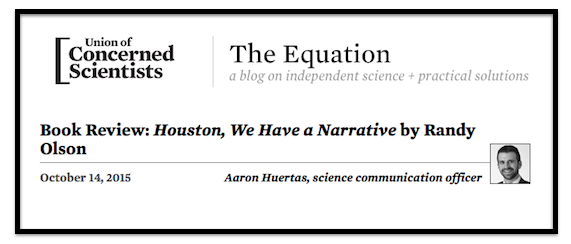
Aaron Huertas of Union of Concerned Scientists has written an accurate/spot-on/pretty much perfect review of “Houston, We Have A Narrative.” UCS was the first NGO to “get it” for my first book. I can now say the same thing for this book, which is why I’ve been a fan and running workshops with them for six years now. Thank you, Aaron, for listening well.

PastedGraphic-4

BOOK REVIEW.  It’s so nice to feel like someone has heard what you were saying.  That’s called “communication.”


SOME SCIENCE ORGANIZATIONS DO LISTEN REALLY WELL

When my first book, “Don’t Be Such A Scientist,” came out in 2009 the very first major organization to contact me and ask me to come speak with them was the Union of Concerned Scientists.  It’s six years later and they’ve pretty much done it again with the review of my new book by Aaron Huertas, one of their long time science communication folks (who has just left to work in the private sector — he will be sorely missed).

It takes a lot of time and effort to write and publish a book.  It can be really frustrating when it finally comes out and you hear some people completely misread and misinterpret the contents.  It happened occasionally for my first book — one major review accused me of advocating “bending the science to tell better stories,” a group of scientists at a major research institution tried to have me un-invited because they thought it was an anti-science book (helps if you actually open the book).  And without saying who, there has already been one blog review for the new book by someone who also seems to have done little more than flip through a few pages and get offended at my critical comments about the humanities.

But Aaron Huertas has written a review that shows not only that he read and absorbed the message of the book, he also adds heft and validity to his review by applying part of the contents to the issue of vaccination.


TAKES ONE TO KNOW ONE

I guess there’s an element of “takes one to know one” — meaning that Aaron understands the book so well because he’s dealt with the same challenges I address.  He hits on so many of the most important points of the book — like “Working the storytelling muscle.”  Thank you for highlighting this point.

It’s one of the biggest frustrations I contend with right now — people saying, “right, got it, ABT, three words, I’m all set.”  We got this with our Story Circles prototypes last spring — one participant asked why there needed to be ten meetings — basically saying, “I got the ABT on the first day and was done.”  What can you do.

That’s like lifting a barbell twice at the gym and saying, “right, got it, barbells, you lift them up, I’m all set,” then going home and never returning, yet thinking you’re buff.


VISITING THE NARRATIVE GYM

It’s about “narrative fitness training” — that’s what Story Circles is about.  I had one scientist at a major institution tell me this summer, “our comms people have done a great job running us through their one day storytelling workshop over the past couple years — we’ve got it down.”

No, you don’t.  Sorry.  It doesn’t happen in one day.  It doesn’t happen in three years of film school.  It doesn’t even happen in an entire lifetime, even if you win an Oscar.  Last spring I asked Eric Roth, author of the screenplays for “Forrest Gump” “Munich” and countless other heavy weight movies, if at age 70 he feels like he’s “got it” on the storytelling thing — he chuckled and said, “are you kidding?”

I’m still figuring this stuff out and I’ve now written three books about it.  Please don’t tell me you’ve learned all there is to know about narrative.  If you have, you ought to be making millions of dollars in Hollywood.  Let me know when that happens.

(FINAL NOTE:  be sure to read Aaron’s account of the ABT Paul Offit tells about his wife administering a vaccination — it’s a powerful demonstration of the faulty thinking of anti-vaccinationists)


#5) The ABT Walk of Life

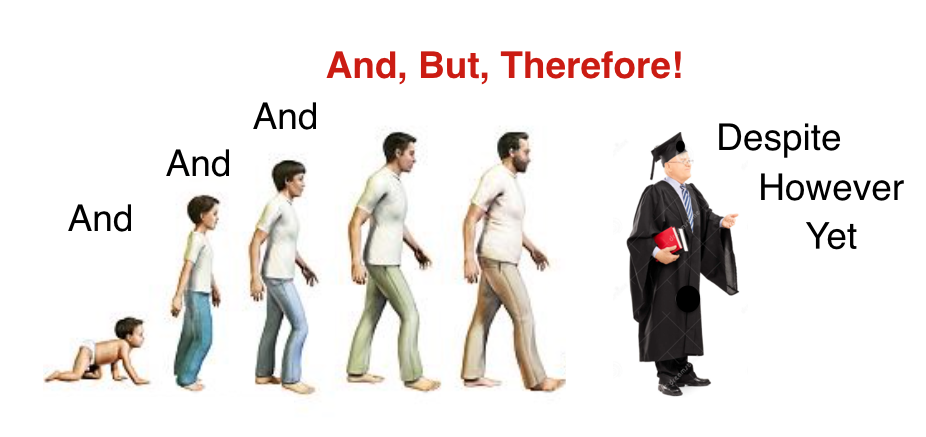
It’s pretty true.

PastedGraphic-2

Ever listen to a kid tell you what he did today?  Ever listen to a professor drone on and on?


ABT, THE NARRATIVE OPTIMUM

My good friend, screenwriter and author Mike Backes pointed this out to me and suggested this figure.

The AAA, which is the non-narrative default state, is common in kids who tell you about what they did today — “And then we went to the store, and then we saw a man, and then he said hello, and then we bought some ice cream, and then …”

At the other end of the spectrum is the learned academic whose thinking is so complex he ends up communicating on five separate narrative planes at once — “the classics are quite challenging despite their popularity, however some people would just as soon study poetry, yet I have a good friend who is fond of making his own haikus, but he’s not the only one who spends his spare time engaged in such activities, nevertheless …”

The real goal is right in the middle of the narrative spectrum.  People hit it at the prime of their lives.  That is when the brain is experienced enough, yet still sharp enough to construct clear, broadly understandable popular singular narratives.  That is when we have the best grasp of the ABT.

Such is the fate of humanity.