# 24) THE NARRATIVE INDEX 2: The Baseline

I have proposed a Narrative Index for evaluating the “narrative strength” of any given text. It needs a substantial amount of text (at least a few thousand words) to have much reliability. But when you analyze large amounts of material throughout history, clear patterns emerge — especially for great communicators.
Voila389

THE LINCOLN-DOUGLAS DEBATES: The perfect showcase for The Narrative Index


LINCOLN THE TORTOISE VS. DOUGLAS THE HARE

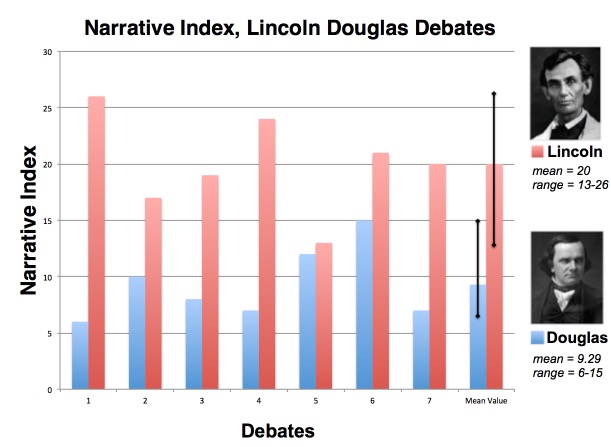
The famous Lincoln-Douglas debates provide the perfect starting point for seeing how much The Narrative Index reveals. In the summer of 1858 Abraham Lincoln — the Republican candidate for Senator from Illinois — squared off in seven debates with the incumbant Stephen Douglas.

All of the debates used the format of 60:90:30 — the opening candidate spoke for 60 minutes, the opponent got a 90 minute rebuttal, then the opener was given a half hour to finish. Just speeches, no questions from moderators. The debates drew huge audiences (tens of thousands) with the texts being widely printed in newspapers. There was some fudging of the transcripts by papers favorable to each candidate, but only minor variations. For my analysis I have used the version presented on the website of the National Park Service.

The result for each debate is a solid sample size of the candidates’ rhetoric — around 10,000 words for each debater’s individual performance. What you see in the figure above for their Narrative Index values is that they barely even overlapped. Douglas’ highest value (15) was only a little more than Lincoln’s lowest (13). Most of the time they weren’t even close.

In simple terms, Abe was telling ABT’s while Douglas was “Anding.” Lincoln had much greater narrative strength. When you read the accounts of witnesses you hear color commentary bringing these data to life. Observers told about how confident and arrogant Douglas was at the start, viewing Lincoln as much less experienced and thinking he would be easily out-witted. But by the fourth debate the audiences were rallying for Abe as Douglas began to sweat. You can see when it came to narrative strength, he was dwarfed by Abe for the first four debates. In the fifth debate he stepped things up a bit, but by then it was too late and he was starting to get ill. By the end he was collapsing in defeat.

THE AAA’er VS. THE ABT’er

For the first four debates Douglas was below 10 while Abe was spiking up to 25. What does this mean specifically?

Look at their opening lines of the first debate. Douglas begins with a string of statements — he’s pure “and, and, and” (AAA) in form:

Prior to 1854 this country was divided into two great political parties, known as the Whig and Democratic parties. Both were national and patriotic, advocating principles that were universal in their application. An old line Whig could proclaim his principles in Louisiana and Massachusetts alike. Whig principles had no boundary sectional line, they were not limited by the Ohio river, nor by the Potomac, nor by the line of the free and slave States …

Now look at Lincoln’s opening — it’s an ABT:

My fellow citizens: When a man hears himself somewhat misrepresented, it provokes him. At least, I find it so with myself; but when misrepresentation becomes very gross and palpable, it is more apt to amuse him. (THEREFORE) The first thing I see fit to notice, is the fact that Judge Douglas alleges, after running through the history of the old Democratic and the old Whig parties, that Judge Trumbull and myself made an arrangement in 1854 …

There you have the fundamental difference in style between the two speakers. Even more telling was one reporter who said, “Lincoln’s “words did not flow in a rushing, unbroken stream like Douglas.”

That says it all. The whole thing about the AAA is that it is the easy, default mode of communication — easy to spew out quickly (i.e. comes out as “a rushing, unbroken stream”) because it doesn’t involve the narrative parts of the brain — it’s just shooting out statements.

Activating the narrative regions slows things down. Lincoln was clearly the more thoughtful speaker, constructing his ideas with more narrative structure.

Though he lost to Douglas in the 1859 election, he of course beat him for President the next year and went down in history as a great speaker. His two inaugural speeches scored 16 and 21, respectively for the N.I. His “House Divided” speech was a 21, his Cooper Union speech was 20, and of course his most famous speech, the Gettysburg Address, while too short to justify analysis (it has just 6 “ands” with 2 “ buts” for an unusually high N.I. of 33) is just one big ABT of three paragraphs total.

Clearly Lincoln had deep narrative intuition. The Narrative Index gives us a means of quantifying this comparatively.

THE KENNEDY-NIXON DEBATES: RADIO VERSUS TELEVISION

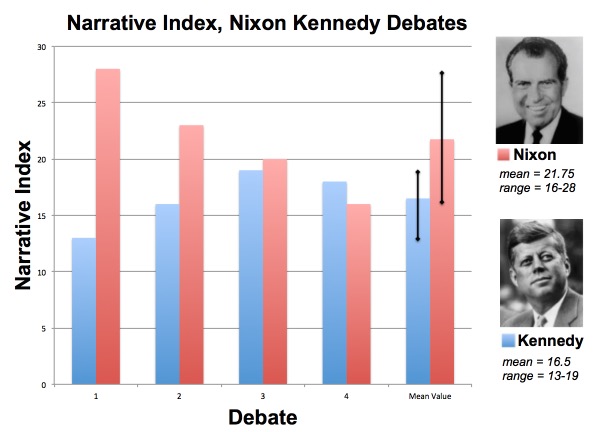
Perhaps the second most famous set of debates in American History were the four held in 1960 between Presidential candidates John F. Kennedy and Richard Nixon. You can see Nixon out-scored Kennedy in terms of the Narrative Index for the first three debates, yet by the third one there was widespread agreement that Kennedy was winning. How could that have been? This is the exception that proves the rule.

For the first debate it was widely reported that polls of people listening on the radio had Nixon as the winner. There’s your narrative content at work. When all that people received was the words through their radio, the narrative structure won out.
Voila388

KENNEDY-NIXON. People heard Nixon win, but they saw Kennedy win.

But television viewers scored it differently. They scored the handsome, relaxed, young Kennedy — who came to be known as the first “telegenic President” — as much more effective than the nervous, sweaty Nixon with the five o’clock shadow. These were elements of communication left out of radio or the written text.

The Kennedy-Nixon debates (as wonderfully presented in David Halberstam’s, “The Powers That Be”) defined the beginning of “The Age of the Television President.” Things were never the same. The divide between radio and television scoring for the first debate shows the relative importance of substance (what they were saying) versus style (how they looked).

INAUGURATION AND STATE OF THE UNION SPEECHES

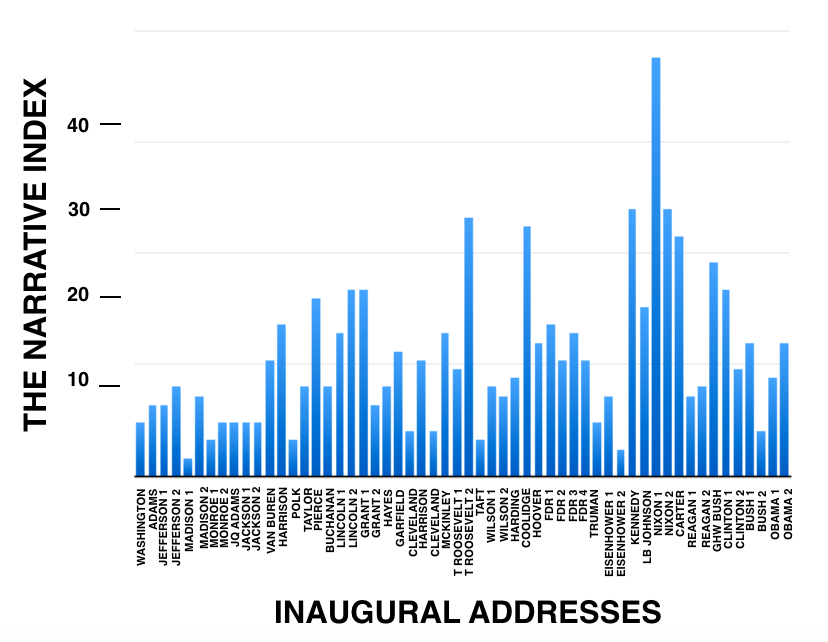
Broader patterns emerge when you look at all the inauguration speeches of the Presidents. There’s substantial variation and at least a few scores that are minor head scratchers. For example, Calvin Coolidge was known as “Silent Cal” — you wouldn’t really expect him to have one of the highest values of all time (he scored a 29). But on the other hand, despite his penchant for few words, he was actually known as a skilled speaker. More importantly, of the six other of his speeches I’ve analyzed, the lowest was still a 14, so he wasn’t devoid of narrative intuition.
PastedGraphic-1 (3)

FIREBRANDS AND DISHRAGS. Nixon bruises while Bush snoozes.

Equally somewhat disappointing is Obama. You’d hope he would score highly, but his two inaugurals are 11 and 15 while his State of the Union speeches range from 12 to 19. It seems to be the case he doesn’t draw heavily on narrative structure. Of the 10 speeches I’ve analyzed, they range only from 9 to 18. I wish I could say his Reverend Wright speech was a barn burner — it’s my favorite of his speeches — but it’s only 15. I’m afraid the numbers are very consistent for him — never into the 20’s. Which means you don’t have to have a huge N.I. to be a great speaker, but it’s still a significant characteristic of most effective communicators, and nobody has labeled Obama “The Great Communicator” as they did with Reagan.

It’s clear a lot of early Presidents hardly ever said “but.” But … there are interesting spikes with Lincoln, Teddy Roosevelt, and eventually the ultimate monster of ambition, Nixon, who set the bar highest.

NARRATIVE ANEMIA

What’s more interesting and even fun are the dishrags. Some folks just don’t seem to bring any narrative content to what they have to say. Not surprisingly, they are all known as kind of wishy washy.

I’m talking about not just those early, polite Presidents, and not just Eisenhower who didn’t score above 10 for either of his inaugurals nor any of his first five State of the Union speeches. The guy I’m talking about is George W. Bush.

Not only did Bush score a mere 5 for his second inaugural, it turns out none of his seven State of the Union speeches — not even after 9/11 — managed to score above 10. They were: 4, 2, 3 4, 5, 4, 4. Is that a surprise? Would anyone ever have called him a great speaker? He was the ultimate “And, And, Ander.” It’s kind of the whole spin Will Ferrell put on him — the guy speaking vacuous statements, reaching for something clever, ultimately only able to say, “strategery” — unable to turn a phrase.

In contrast, Nixon’s State of the Union speeches for 1970 to 1974 were 27, 16, 23, 18. He always had something urgent and important to say. But did Nixon really have that good of a feel for narrative structure? Yes. Just look at how he opens his record-setting first inaugural (scored a 46).

He begins with an eloquent ABT:

“I ask you to share with me today the majesty of this moment. In the orderly transfer of power, we celebrate the unity that keeps us free. Each moment in history is a fleeting time, precious and unique. But some stand out as moments of beginning, in which courses are set that shape decades or centuries. This can be such a moment.” (ominous opening words from the eventual captain of the Titanic)


MODERATORS: THE ABT DRIVERS

As you can imagine, countless fascinating observations begin to emerge from this single index. In the third and final post I will get deeply into the current Presidential Debates. But before I do, let’s take a look at the basic dynamic of “ABT Driving.” What I mean by this is using the ABT elements to basically “advance the narrative.”

This is the fundamental need for narrative, in order to keep it interesting — it must be advanced. You must constantly be adding sources of contradiction, then driving for consequences. We can see this at work clearly with the moderators of today’s television debates.

Television producers live in dread fear of boring their audience. It’s the job of the moderators to prevent this by interrupting the debaters, and more importantly, interjecting conflict by squaring them off against each other. You hear the moderators saying over and over again, “Candidate A, last week you said X, BUT your opponent said Y, how do you reconcile this?” If they are doing their job properly they are constantly driving the narrative dynamics.

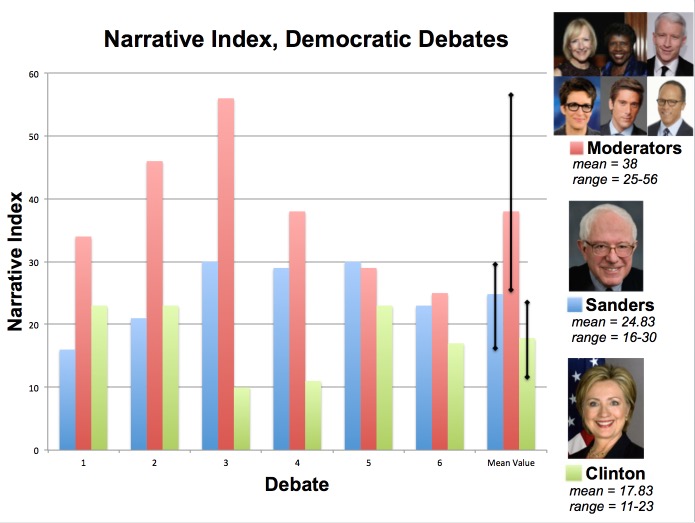
This ends up showing clearly in the collective N.I. value for the moderators of each debate. Look at the third Democrat Debate — they reached 56, which is unheard of for a speaker. And you can even add to that a fair amount of non-narrative logistics explanations and pleasantries. Clearly their job is to drive the conflict.
Voila399

THE ABT DRIVERS: Clinton and Sanders are kind of a big whatever in narrative terms, but far more interesting is the role of the Moderators. It’s their job to “advance the narrative.” This is reflected in the N.I.


SO WHAT IF THERE WAS A PRESIDENT WHO NEVER, EVER SLIPPED BELOW A NARRATIVE INDEX OF 20?

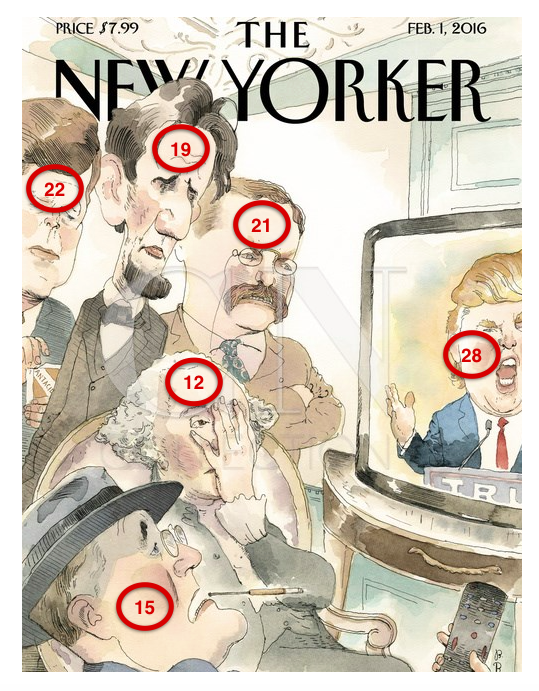
Guess where this all leads. I’ve analyzed hundreds of speeches since last summer. I’ve found only one politician who has NEVER given a speech or debate performance below 20. Guess who …
#23) THE NARRATIVE INDEX 1: A New Communications Tool

This is the first of three posts about what I believe to be a new and valuable communications tool. I have been trying since last September to interest the major political blogs in The Narrative Index (or N.I.) but they seem to be skeptical of both its newness and simplicity. Let’s see what you think. The data speak for themselves.

DO THE MATH: Guess where these posts are going to lead.


AN INDEX OF NARRATIVE STRENGTH

Some texts grab your attention and don’t let you go. Other texts put you to sleep. Wouldn’t it be nice if there were a single number that reflected this property?

Just over four years ago when I came across the extremely simple concept of “The Rule of Replacing” (as espoused by the co-creators of the animated series “South Park”) I found myself saying “surely it can’t be that simple.” Since then I’ve put that skepticism to the test though countless talks, a TEDMED presentation, a letter in Science, a webinar, and finally an entire book about it last fall titled, “Houston, We Have A Narrative.”

My main activity this year is fulfilling the vision of the book — propagating the ABT Framework by creating Story Circles Narrative Fitness Training which you can read about on our website. The next event will involve 40 biologists from USDA, USFWS and USGS next week in Ft. Collins, Colorado.

As a result of all this effort, I’m now certain that narrative structure, at it’s core, is indeed as simple as ABT. So what’s next?

Last summer I had a new revelation about the ABT template. It was the thought that if you were to use the Rule of Replacing, all else equal, when you finished with a given text you would have altered the ratio of the number of “buts” to “ands.” This ratio becomes a single number reflective of the strength of the narrative content of the material. Here’s how it works.


THE “BUT” WORD

“But” is the word of contradiction in the ABT. It is the heart and soul of narrative. There are lots of other words of contradiction (however, despite, yet), BUT … if you were to quantify it, you would easily see that BUT is the most common.

In fact there is a website that presents the 5,000 most common words in The Corpus of Contemporary English. Here’s how a few interesting words score on that list (how frequently they are used in the English language):

and – 3
but – 23
or – 32
while – 153
yet – 276
however – 285
despite – 772
instead – 997

“But” is the only connector word of contradiction in the top 100, aside from “or” which doesn’t have any narrative strength.

More importantly, all you have to do is look at the front page of a newspaper to see that most stories (if they are written well) begin with a few facts then a “but” (I’m looking at the front page of the NY Times for Feb. 13, 2016 and I see three of the four stories above the fold have this structure — two using “but,” one using “instead,” — and now I’m looking at Sunday Feb. 21 and see 3 of the 5 stories on the front page open with the ABT structure — again two “buts” and an “instead”).

“But” is central to having good narrative strength. At the other end of the spectrum (specifically “The Narrative Spectrum” as I labeled it in my book) is the template of, “And, And, And” text or AAA. This is text that is almost devoid of narrative content — just a string of comments tied together by the word of agreement, “and.”

The bottom line is that the more times you are saying “but” relative to “and” the more narrative strength there is to the content you are presenting. To quantify this ratio I have created this single calculation:

      THE NARRATIVE INDEX = Buts/Ands X 100

I’ve had lengthy discussions with colleagues — especially my old buddy Bill Dennison at University of Maryland Center for Environmental Science, who will be posting his own essay tomorrow on applying the Narrative Index to the co-discoverers of the theory of evolution by means of natural selection, Charles Darwin versus Alfred Russell Wallace. Out of those discussions I’ve opted for simplicity by just keeping it as the ratio of buts to ands, multiplied by 100 to make it a whole number.

To calculate it for a given text, all you do is copy the material into a word processor, search for “and” and “but,” record their abundances, then divide.

Here, let’s do it for the story on Scalia on the front page of the Feb 15, 2016 NY Times.

But – 10
And – 27
Narrative Index (But/And) X 100 = 37

That’s actually a pretty high value, but to be expected for the front page of the NY Times — no room for ambling, unfocused AAA presentations there.

So that’s how simple it is to calculate. Try it for yourself on a body of text. In the next post I’ll set to work showing you the patterns that emerge for everyone from scientists to politicians.

#22) Hillary is Too Much of a Scientist

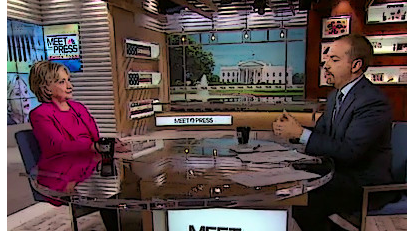
I want to support Hillary but she simply does not have the communication style that is needed for today’s world. Yesterday on Meet the Press, and last week on Hardball and Bill Maher they focused on her tendency to give nuanced answers. It just doesn’t work in a world of too much noise.

THE PRICE OF AND, AND, AND.   Hillary’s approach to communication is not suited for today.


WHAT IS NUANCE FOR, WHEN NO ONE LISTENS ANY MORE?

Trump has punched his way to the top through the use of one key element: simplicity. Bernie Sanders has followed in his footsteps. But Hillary still hasn’t quite figured it out.
 
Trump had it nailed from the outset with his simple moronic narrative slogan “Make America Great Again.”  Bernie has had an equally simple message all along which he boiled down to one line last week.  Here is Chuck Todd quoting his line yesterday on Meet The Press.
 
CHUCK TODD:  Senator Sanders called the entire business model of Wall Street a fraud …
 
HILLARY CLINTON:  I think it’s kind of an extreme statement that once you take a hard look at it is hard to understand.  When we talk about Wall Street are we talking about every bank or are we talking about a particular part of New York? That’s never really clarified. What I believe is that there are good actors and bad actors, actors in every part of our economy.
 

THE SAD TRUTH OF TODAY

That exchange is a sad portrait of what I’m afraid the future holds for Hillary. She just doesn’t get it when it comes to concision. That’s why she has had no slogan to her campaign. I wish today’s world was as decent and intelligent and thoughtful and listening as the world for which she is designed. But it’s not.
 
Look at what Sanders said — that Wall Street is built on fraud. Is that not the broad sentiment of today? Is that not the core message of the movie “The Big Short” that is about to clean up at the Oscars?
 
Yes, I know the situation is more nuanced than that, but when it comes to mass communication nuance is death, unless you’re going to put together an entire detailed communications campaign that is structured around conveying nuance. Which is not impossible, but it takes more effort than just throwing all the details out using the “and and and” (AAA) form.
 
Hillary is going to get whomped tomorrow night in New Hampshire. She essentially got whomped last week in Iowa despite “winning.” Regardless of the actual politics of what she stands for I’m afraid her approach to communication is more suited to the 1970’s than today.
 

THE SINGULARITY OF WOMEN POWER

A final sad comment on Hillary. Chuck Todd confronted her about Madeline Albright’s semi-humorous statement last week that there is a special place in hell for women who don’t support women candidates. Hillary should have embraced that statement firmly saying that’s right, it’s time for a woman in the presidency. But instead she backpedaled, dismissed it to some extent as “that’s just Madeline” and passed up yet another opportunity for simplicity in her messaging. It is time for a woman president, she ought to be the one, and she should just take a chance and go with the gender element. But she’s not.  I’m guessing it’s because of some polling data she’s following.

#21) “Our yearning for certainty”: The Narrative Dynamic of True Crime TV

Kathryn Schultz in The New Yorker has a great article about the driving force of today’s true crime tv/radio obsession.  At the core of the trend is the same desire for “positive patterns” I discussed at length in my book.  She sums it up as “our yearning for certainty.”  Same same.  It’s inevitable and it drives a lot of tragic misdeeds, including how some TV shows are made.

UNSAVORY AVERY.  Who knows if he’s innocent, but he’s clearly no saint.


THE COURT OF LAST RESORT

If you’re into the latest true crime TV series, “Making a Murderer,” you should read the excellent article in The New Yorker yesterday by Kathryn Schultz.  I binge watched 8 of the 10 episodes over the holidays, which was enough to get me to the point of feeling the story is interesting, however … there was a definite stench of confirmation bias in how it was put together.
 
That bias led to a form of mass hysteria as over 400,000 people stampeded (via the internet) to the White House signing a misguided petition begging Mr. Obama to fix everything using his magic powers.  As Schultz points out, it wasn’t even a federal case so there’s zippo the President could do even if he wanted to.
 
Schultz nails the bottom line with a single phrase — “our yearning for certainty.”  It is a phrase that is so deep.  It underpins everything from false positives in science to all of religion.  It is a basic human need that can overpower even the greatest physical evidence.  And it ultimately overpowered the filmmakers.
 
Her article is tremendous in so many ways — not the least of which is near the end as she points out the veritable lack of moral conscience from the makers of both “Making a Murderer” and NPR’s hit “Serial” with this great passage:
 
But neither “Serial” (which is otherwise notable for its thoroughness) nor “Making a Murderer” ever addresses the question of what rights and considerations should be extended to victims of violent crime, and under what circumstances those might justifiably be suspended.  Instead, both creators and viewers tacitly dismiss the pain caused by such shows as collateral damage, unfortunate but unavoidable. Here, too, the end is taken to justify the means; someone else’s anguish comes to seem like a trifling price to pay for the greater cause a documentary claims to serve.

#20) Hillary Does Not Have A Narrative

She doesn’t. A shopping list of “things to do” is not a narrative. Trump has a narrative. It may sound stupid to many, but he has one and it’s on his hat. Yes, effective mass communication is that simple. Sorry.

PastedGraphic-5

IT’S IMPORTANT TO KNOW WHAT A NARRATIVE IS, AND TO KNOW WHO DOESN’T HAVE ONE.


AND, AND, AND …

Last night on MSNBC’s Hardball with Chris Matthews he had on Senator Tammy Baldwin (D, Wisconsin) who is a big supporter of Hillary Clinton.  In response to the other guests on the show saying that Hillary is lacking a clear message/narrative, she said this about the thoughts of Hillary’s followers:
 
“… they do think she has a very clear message … she’s about jobs and equal pay and all the renewable energy jobs that we have the potential to create, she’s about healthcare and she’s about healing some of the deep divides we have in our nation.”
 
That is NOT a narrative.  That is a shopping list.  That is an “And, And, And” statement.


TRUMP HAS A NARRATIVE

You want to know what “having a narrative is about” just look at Donald Trump’s hat.  Yes, I know it seems moronic, but the fact is he has a clear ABT structure to his campaign which is basically, “America used to be a great AND mighty nation, BUT we’ve slipped in the world, THEREFORE it’s time to MAKE AMERICA GREAT AGAIN.”
 
That is what is called having a singular narrative — a singular voice that the masses can rally around.  Obama had HOPE.  Hillary has … a bunch of stuff.
 
It’s bad enough that Hillary has not been able to formulate any sort of singular theme, but it’s even worse that major supporters like this Senator don’t even see the mistake she is making.  I wanted to support Hillary initially but now I’ve shifted to Bernie who at least has a clear theme of EAT THE RICH!
 
Go Bernie!

#19) It’s the Problems, Dummy

Trump says the country is falling apart, but White House Chief of Staff Dennis McDonough says he’s baffled why Trump and the other Republican Presidential candidates would say this.  Really?  Don’t you think they kind of need some problems to match their solutions if they want to have “a narrative”?  As I continue to say, Donald Trump embodies every principle of narrative presented in my new book.  He is the living demonstration of the power of narrative — NOT storytelling — is everyone aware of the difference?

PastedGraphic-1

“I DON’T REALLY GET IT.”  Well, that’s the truth, Mr. McDonough.  At least he’s honest about it.  But what’s not to get about Trump?


WHY THE LEFT IS BAFFLED BY TRUMP

It’s about narrative.  Trump has a mastery of it, people on the left don’t.  It’s kind of that simple.  His speech last Thursday in Vermont was a tour de force of his narrative skills.  Not storytelling.  He’s a lousy, choppy storyteller.  He’s no Ronald Reagan.  But what he knows is narrative.
 
Narrative is about “problem-solution.”  It is at the core of storytelling, but it’s only one part of a story.
 
Yesterday on “Meet the Press” White House Chief of Staff Denis McDonough sat there sounding totally confused as Chuck Todd asked him about Trump’s penchant for saying the nation is on fire and about to explode.
 
Here’s what he said:  “I don’t really get it.  What I see is an America that’s surging.”  He lists all the FACTS of how vibrant and successful our society is at the moment (as if Trump cares).  He continues by saying, “I do not understand why the Republicans — each of them — continue to run down America.”
 
Well, I understand why.  It’s kind of simple.  Without problems, you can’t have solutions.  And without problems and solutions, you have no narrative.
 
Trump gets this better than all the rest — so much that he has his narrative on his hat, “Make America Great Again.”  There’s the statement of the problem in his view — that America has slipped.  He gets this stuff.  He’s spinning absolute circles around his opponents and the left is utterly lost.
 
There are dark days ahead.  That’s my fear-mongering statement of the problem.

#18) Trump Language Analysis: Analysts Bringing AAA’s to an ABT Fight

Donald Trump knows narrative. That’s the simple bottom line, with the emphasis on simple. At the core of effective narrative is the ability to find the simple singular theme — which is not what happens when people on the left take to analyzing Trump’s use of language. They end up with shopping lists of all the things Trump does, then usually package that with a tone of derision and dismissal. Trump has one huge advantage over the left that boils down to one word that he truly grasps — “simplicity.”


AND, AND, AND … here’s a guy presenting a shopping list of all the things Trump does. This doesn’t help things. His analysis is on the right track, but is so complicated as to be useless — not deserving of the smug voice he delivers it with — as if he’s solved the riddle of Trump.


TRUMP IS LOOPY

Question: What’s the one asset Donald Trump has above all the other candidates, and really, pretty much all of today’s politicians? Answer: He has deep narrative intuition. He understands narrative and he wields it like a bat.

He’s not a great storyteller. Narrative and storytelling are not the same. Ronald Reagan was a great storyteller. Trump doesn’t tell great stories. But what he has is a powerful grasp of narrative, meaning the basic problem-solution dynamic.

He speaks in tight loops of problem-solution. And he gets to the solutions immediately and simply. No beating around the bush. No answers of “It’s complicated.” Just simple answers, producing tight, closed narrative loops, which people really like. Even if the solutions are unrealistic and dishonest.

You won’t find the same pattern in any of the other candidates. Ted Cruz has almost none of this intuition. Jeb Bush has even less.

There has never been a politician like Trump. He is custom made for today’s media-driven world — which is why Fox and MSNBC swoon over him.

The Democrats had better stop ridiculing him, stop making predictions that he could never win, and start understanding this thing called narrative that he has a mastery of. I published a book on it last fall. He embodies everything that I wrote about. He’s not someone to be laughed at.

#17) Yet another ABT Speech: MLK’s “I Have A Dream”

Everywhere you find effective communication you’ll almost certainly find the ABT at work. There’s a lot of reasons Martin Luther King, Jr’s “I Have A Dream …” speech is one of the greatest speeches in American history, but one of them is strong narrative structure. Look how it opens — pure ABT.

CLARITY OF MESSAGE. Yes, it is that simple. He could have gone off in ten different directions right from the start, but he didn’t. After an opening greeting, he delivered three sentences of exposition, then got right down to business, stating the problem followed by a statement of consequence.


STRUCTURE MATTERS

It’s kind of hard to say which part of a narrative is most important. If you confuse or bore people at the start, you’ve lost them. If you don’t close well, the whole effort can be a waste. And it kind of helps to not make a mess of things in the middle.

But in a world of short attention spans, it is increasingly crucial to have a strong opening. People are making their minds up whether to listen from the start.

Lots of people over the ages have analyzed MLK’s great speech. There’s tons to praise in it, and given the seriousness of the moment and enormity of his audience in front of the Lincoln Monument, he pretty much couldn’t go wrong. But regardless, it still mattered whether he bored, confused or drew the audience in from the start. By opening with solid ABT structure, he guaranteed the latter.


IMPERFECTION BUT WHO CARES

Once you recognize that the speech opens pretty close to perfectly with solid ABT structure, I think it’s worth conceding that the rest of it, while powerful and effective, isn’t so air-tight for narrative structure as to deserve the label of “perfect.” What is good is the basic messaging of using a lot of repetition.

About two thirds through he hits a stretch where he starts eight consective sentences with “I have a dream …” That’s a little bit “And, and, and-ish,” but that’s okay. By that point he’s hammering home his message through repetition.

What’s worth considering is that there might have been a story he could have told. As great as the speech was, there could well have been an even better, more powerful version with tighter narrative structure. Who knows. That’s the thing about the narrative challenge — you can never prove that there doesn’t exist a better version.

But the key point is that MLK had deep narrative intuition, and that showed itself by how he opened the speech. He started simple, drew his audience in, then let loose with the exhortations they needed and wanted to hear.


AND NOW FOR SOMETHING LESS IMPRESSIVE …

In my next blogpost I’m going to go to the opposite end of the spectrum by looking at what is considered by many scholars to be the worst speech ever given by a U.S. President — Jimmy Carter’s 1979 speech on malaise. Guess what he opens with — a defective ABT mess that is basically a “double but” situation. Ugh. Case in point.

#16) FOR STUDENTS OF THE ABT: The delicate power of the ABT words

We’re breaking new ground with the ABT. You won’t find any of this in textbooks. For those of you who have taken part in Story Circles or read, “Houston, We Have A Narrative,” you should find this extra interesting. It’s an example of what I think is the subconscious avoidance of the BT words (BUT, THEREFORE) in a delicate situation. Check out what I’m saying here and see if you agree. If you have thoughts, please send me an email at info@randyolsonproductions.com

The words “but” and “therefore” (or “so”) are powerful in conversation. They are the core words of narrative — the words that cause the brain to activate the narrative centers. It’s a standard rule of thumb in dispute resolution to avoid the word “but” and most improv instructors (who are trying to work in the direction of affirmation) also ban the word. “But” is the prime word of contradiction, and “therefore?” is a word that people use in frustration when they are wanting to know what the speaker is getting at. Which means when things are delicate, you probably want to use them sparingly.


THE DIPLOMACY OF INDIVIDUAL WORDS

The New Yorker had a fairly painful and delicate article over the weekend about rape. The author, Jeannie Suk, was herself involved in the issue of a sexual assault case at Harvard that was presented in a new documentary. The article is both reporting on the politics of the documentary, as well as a statement of her opinion.

Because of the extremely sensitive nature of the issue, you can tell she has chosen every single word very carefully. What is interesting is to examine the ABT structure of her final paragraph.

Looking at it from the ABT perspective (and this is what I mean by the term “the ABT Framework”) you can get a feel for how delicate her word selection is. I’ve dropped in BUT and THEREFORE where you can sense they could go if you wanted to use them.

LAST PARAGRAPH OF THE ARTICLE:

Sexual assault is a serious and insidious problem that occurs with intolerable frequency on college campuses and elsewhere. Fighting it entails, among other things, dismantling the historical bias against victims, particularly black victims—and not simply replacing it with the tenet that an accuser must always and unthinkingly be fully believed. It is as important and logically necessary to acknowledge the possibility of wrongful accusations of sexual assault as it is to recognize that most rape claims are true. And if we have learned from the public reckoning with the racial impact of over-criminalization, mass incarceration, and law enforcement bias, we should heed our legacy of bias against black men in rape accusations. The dynamics of racially disproportionate impact affect minority men in the pattern of campus sexual-misconduct accusations, which schools, conveniently, do not track, despite all the campus-climate surveys. Administrators and faculty who routinely work on sexual-misconduct cases, including my colleague Janet Halley, tell me that most of the complaints they see are against minorities, and that is consistent with what I have seen at Harvard. (BUT) The “always believe” credo will aggravate and hide this context, aided by campus confidentiality norms that make any racial pattern difficult to study and expose. (THEREFORE) Let’s challenge it. Particularly in this time of student activism around structural and implicit racial bias pervading campuses, examination of the racial impact of Title IX bureaucracy is overdue. We are all fallible—professors, students, and administrators—and disagreement and competing narratives will abound. But equating critique with a hostile environment is neither safe nor helpful for victims. We should be attentive to our history and context, and be open to believing, disbelieving, agreeing, or disagreeing, in individual instances, based on evidence.

The first six sentences of the paragraph are a series of “and’s” with the fourth sentence even starting with the word “and.” This material is all exposition, setting up the overall argument using the ABT structure.

The seventh sentence is the statement of opinion. In the language of Gerald Graff, author of “They Say, I Say,” the first six sentences are the “they say,” the seventh sentence is the “I say.”

Try reading the sixth and seventh sentences the way she has written it, then try it again including the BUT. You can feel that the latter version is a little more powerful, a little more aggressive, a little more pushy — which is what she didn’t want to finish with given the sensitivity of the issue.

And then look at the next sentence — it is the clearly the statement of consequence or action. She is offering up her recommendation of what to do about this predicament (“Let’s challenge it.”). Of course hardly anyone uses the word THEREFORE, but you could definitley drop in “So, let’s challenge it.” But again, if you did, you’d be making the text more pushy.

This is what I’m saying about the delicate use of language here. Remembering that “the power of storytelling rests in the specifics,” you can see she went the opposite way, intentionally making her content less powerful.


THE FIVE PART STRUCTURE

The last paragraph is, of course, her summary statement of the article. It is also structured not just with the ABT, but actually with the five parts referred to by screenwriting guru Frank Daniel in his 1986 speech that I quote in my book. Here’s what Daniel said:

THE FRANK DANIEL QUOTE: In a dramatic story the pattern usually for the connecting scenes is: “and then,” “but,” “therefore,” “but,” and towards the culmination “mean­ while.” If you don’t have this “but” and “therefore” connection between the parts, the story becomes linear, monotonous. Diaries and chronicles are written that way, but not scripts.

If you look at the remainder of the text, you see the final two sentences match the five part structure described by Frank Daniel. Sentence #11 actually starts with BUT, and Sentence #12 is the culminating statement, “We should be attentive …”

This is what I’m talking about with the term ABT Framework. Once you learn these words and realize the narrative roles they play, you can start to break down the narrative structure of individual sections of text.

In this case, the ABT structure is present throughout the article, and nowhere more than in the final, wrap up paragraph.


MY ADVISORY COMMITTEE

I’ve now formed an Advisory Committee for Story Circles who are sort of my sounding board for the development of these sorts of thoughts and observations. One of them felt the BUT should be dropped into the third sentence, but … I disagreed. I think all the opening six sentences are statements of fact, including the third sentence. It’s the seventh sentence that says, “will aggravate,” which is basically a prediction, meaning it’s her statement of opinion.

And here’s one last narrative dimension of this one paragraph. I think those first six sentences are kind of convoluted with much of it being extraneous to her more important point. And actually, I have a feeling the very nature of it being so indirect and muddled as she’s trying to summarize her argument further reflects the delicate and hesitant nature of what she’s trying to say. It’s a very volatile subject at the moment for which I would expect even a well written essay like this one to have these sorts of narrative features.

#15) Fun with Climate in Paris?

As a rule, environmentalists are largely humorless. When it comes to climate, this is compounded by an air of self righteousness, making them prime targets for ridicule. Tonight in Paris we’ll see if Marc Morano is able to take advantage of this. It shouldn’t be too hard.

HELPING YOUR ENEMY’S CAUSE? Whoever is behind these posters in Paris, do they realize what they are doing? Have they not heard of Richard Lanham’s book, “The Economics of Attention”? Attention is money. They might as well donate to Marc Morano’s climate skepticism cause to help him with publicity.


WHAT’S THE FUNNIEST CLIMATE MOVIE EVER MADE?

When it comes to climate and humor it’s pretty much of a contradiction in terms. The only humor in “An Inconvenient Truth,” was Gore making fun of his clueless elementary school science teacher who, “probably grew up to become the science advisor to the current (Bush) administration” (way to alienate the Republicans you’re hoping to reach in the first ten minutes of your movie).

There are stacks of climate documentaries over the past decade, almost none of them funny. My friend Robbie Kenner did manage to finally bring a smidgen of humor earlier this year to “Merchants of Doubt,” but only a smidgen as it was still set in the overall holier than thou tone that has characterized the climate movement from the start.

There’s actually only one truly brilliant piece of climate comedy over all these years, which is the group in Australia behind, “The Hamster Wheel: Lord Monckton,” a four minute video in 2011 that punked oddball climate skeptic Lord Monckton at a level as skilled or better than “The Daily Show” in the old days. It was a true masterpiece.

But all the rest are overly-somber pronouncements on how we’re all doomed — the lecturing voice of a largely humorless community. So now let’s see how they deal with someone making fun of them.


A CLIMATE CLOWN IS BORN

In 2008 I took my shot at having fun with the climate issue. Following my movie “Flock of Dodos” in 2006 lots of people asked if I could make an equally entertaining movie about the attacks on climate science. I gave it a shot. I made, “Sizzle: A Global Warming Comedy.” You know what happened? Most environmentalists hated it.

The word got out I had made a piece of “climate humor.” Initially there was interest. I was invited to submit it to at least five “environmental film festivals,” in DC, Georgia, California, Wyoming and Colorado. But all of them rejected it. Two of them even wrote emails implying the overall tone of it was inappropriate. Climate bloggers were even worse, and the scientific journal Nature (that bastion of cinema savvy) gave it the only rotten review of my entire filmmaking career out of more than 100 published.

In the end we premiered the movie in Hollywood at the Outfest Gay and Lesbian Film Festival (two of the leads were gay and the festival values humor and not taking oneself too seriously) and the Woods Hole Film Festival (they were open minded enough to realize the movie was pro-climate movement, it just had an irreverent attitude, which is largely forbidden in the traditionally reverential environmental world).

One of the most memorable characters of the movie was budding climate skeptic Marc Morano. At the time he was the spokesman for the loudest climate skeptic in Congress, Senator James Inhofe. We had fun interviewing him in a senate hearing room. He was intrigued with filmmaking and seemed to have an inate feel for entertainment. I enjoyed his sense of humor and as a result have stayed in touch with him over the years, including having him on a panel discussion at a screening at Syracuse University. Also, I lobbied Robbie Kenner to include him in “Merchants of Doubt.”


TRYING TO WARN THE CLIMATE WORLD OF AN EMERGING VOICE

In 2010 I opened my new blog, The Benshi, with a four part series about Marc Morano which angered a number of climate folks. But I concluded it with a clear warning to watch out for Morano and more importantly to quit debating him on TV. It is a no-win situation to engage Marc in debate. He is faster than any climate advocate, and because he has the power of ridicule on his side, the whole field is tilted. I said back then the only people who should engage with him are trained comedians.

Nevertheless, just last year Bill Nye simply couldn’t resist the Morano bait and went down in flames to him on CNN. Excerpts of the debate were in “Merchants of Doubt,” prompting Indiewire (the most highly respected news source in the independent film world) to say, “There’s a reason Bill Nye isn’t known as The Public Relations Guy.”

A friend of mine with NPR said he was in their newsroom of his studios where the debate was up on the TV live as everyone in the room laughed at Nye while asking about Morano, “who is this guy?” — realizing the power of his ability to attack. He is a machine and has been literally unstoppable over the past decade — just as I warned in 2010.

Now, tonight, Marc Morano is in Paris, reaching for his highest achievement to date.


THE WORLD PREMIERE OF “CLIMATE HUSTLE” IN PARIS

Marc enjoyed “Sizzle.” On the Syracuse panel he told about how he received the DVD of “Sizzle” in 2008 just as everyone he knew on Capitol Hill was getting worn down and fed up with the climate issue. The humor of the film proved popular as the DVD was passed around from one congressional office to another.

He was intrigued by the power of humor, was intrigued by the power of film, has a natural ability with humor (many of the reviews of “Merchants of Doubt” called him the best thing in the movie, including a kid at the test screening I attended who said, “I know I’m not supposed to like him, but the guy in the movie I’d most want to have a beer with is Marc Morano”).

His new movie “Climate Hustle” premieres tonight in Paris. I’m willing to bet money that at least it won’t be boring, which is a whole lot more than can be said for the vast majority of the well intentioned, generally-sucky efforts of environmentalists. I’m not a supporter of Marc’s agenda and never have been, but I do appreciate that he is at least a soldier in the War on Boredom, which is what I think is truly the greatest threat to humanity.